
Carbon borders as industrial policy: CBAM, the ETS and UK manufacturing
Part of the Policy series: where the rules stand in Northern Ireland, who decides them, and what to do about it. Updated as the rules change.
The argument in brief
Both carbon border charges will apply to UK trade from January 2027. The EU CBAM has applied to imports since 1 January 2026: EU importers owe the EU carbon price on UK steel, aluminium, cement and fertiliser, minus any carbon price effectively paid in the UK, net of free allowances. The UK CBAM starts on 1 January 2027. Goods made in Northern Ireland are outside the EU CBAM and inside the UK one.
It works like a tariff on carbon content; in law it is a tax collected by HMRC. It is charged only on imports and varies with the country and plant of origin. For steel from the US, Brazil, China or India it adds about £19 a tonne on HMRC’s 2027 illustration, with little or no relief, and rises as free allocation ends.
There are three broad options, and each has its advocates:
- Keep the UK CBAM and UK ETS as they are, with free allowances phased out as the border charge takes over. This is the Government’s position.
- Link the UK ETS with the EU’s, which could lead to mutual exemptions from each other’s CBAM. Negotiations on a linking agreement concluded at the UK–EU summit on 20 November 2026. Both sides aim to apply it from 2028; it is not yet concluded or in force (Joint Statement, para 49).
- Scrap both, as the Conservatives (April 2026) and Reform UK (26 October 2026) have pledged. They point to industrial electricity prices among Europe’s highest, refinery and blast-furnace closures, and a border charge that raises costs for farmers and fabricators.
This piece sets out what each option would mean for Northern Ireland firms, and the case each side makes. Facts checked to 30 October 2026, updated on 11 November 2026, and updated on 21 November 2026 for the UK–EU summit of 20 November 2026.
The lifecycle at a glance
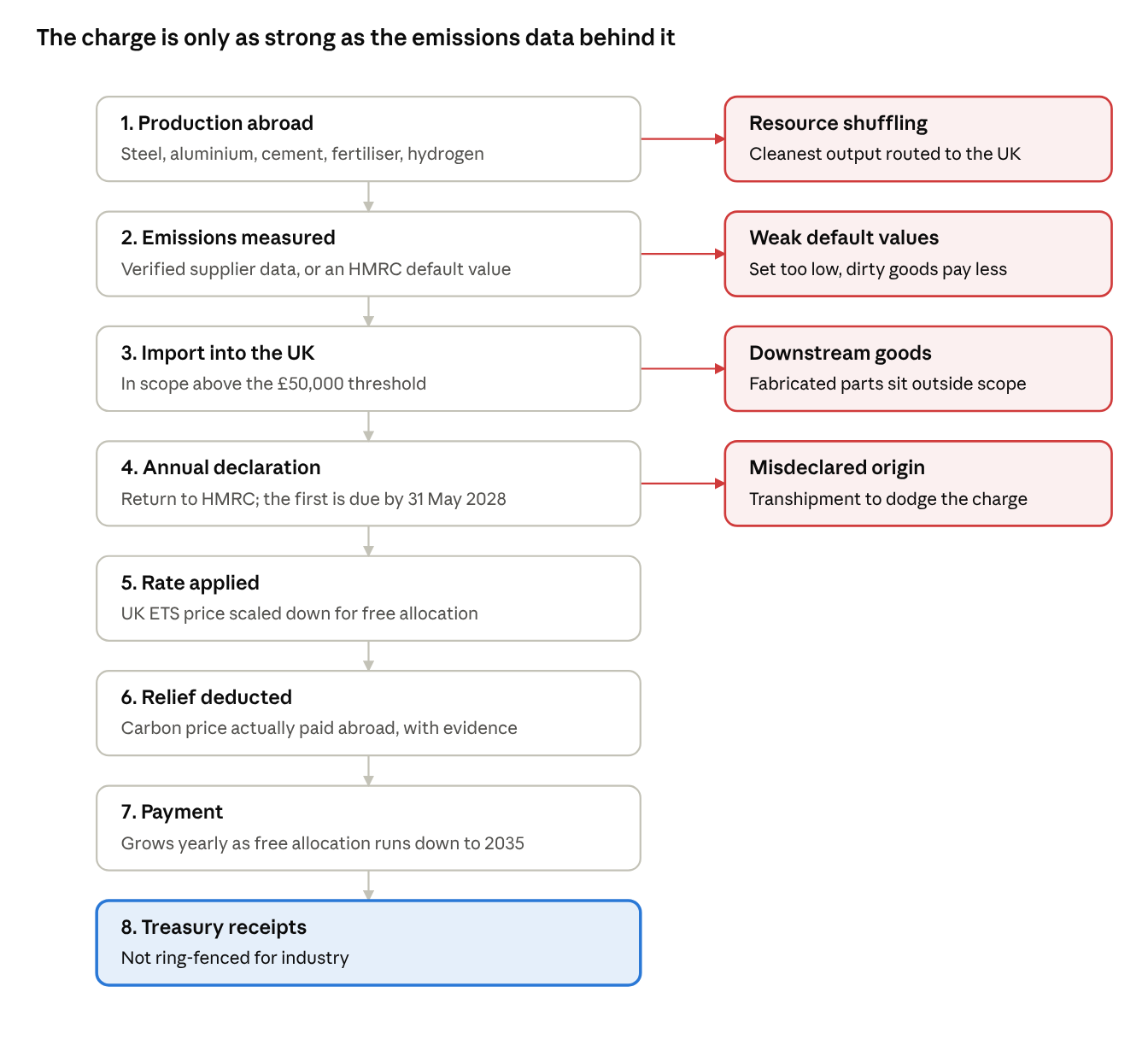
Every leak sits in the first four stages, before any rate is applied. Exporters can route their cleanest output to the UK, hide behind low defaults, ship finished parts instead, or misdeclare origin, so the data rules matter more than the headline rate.
Then and now (2023 to October 2026)
Both CBAMs will be charging UK firms by January 2027, Negotiations on the UK–EU link, which would take each side’s goods out of the other’s CBAM, concluded on 20 November 2026, but the agreement is not yet in force. Both CBAMs apply as planned until each side legislates. The Budget of 28 October 2026 left the UK CBAM start date and rates unchanged and opened a consultation on adding refinery products.
| Rule or instrument | 2023 | Now (with date) | What changed and why |
|---|---|---|---|
| EU CBAM | Transitional reporting from 1 Oct 2023 | Definitive since 1 Jan 2026 on iron and steel, aluminium, cement, fertilisers, hydrogen and electricity. Q3 2026 certificate price €82.32/tCO₂e (5 Oct 2026), before the free-allocation adjustment. Certificate sales from Feb 2027; first declaration by 30 Sep 2027. NI-made goods outside it (Commission Q&A 7.14) | Moved from reporting to paying on schedule, as EU free allocation starts to fall |
| UK CBAM | Announced 18 Dec 2023, for 2027 | Starts 1 Jan 2027 UK-wide, including NI; same goods minus electricity; £50,000 threshold. Rate regulations (SI 2026/809) approved by the Commons 14 Oct 2026. Illustrative 2027 rates for all five sectors, from £1.45/tCO₂e (fertiliser) to £9.79 (aluminium); iron and steel £9.69 (16 Oct 2026). First return and payment by 31 May 2028. Budget (28 Oct 2026): start date and rates unchanged; ferro-silicon (7202 29) added to exceptions from 1 Jan 2027; consultation on adding refinery products closes 20 Jan 2027 | Legislated in the Finance Act 2026 to stop leakage as UK free allocation ends. Indirect emissions excluded until at least 2029 |
| UK ETS free allocation, CBAM sectors | Mostly free | Phase-out from 2027: HMRC’s 2027 formula applies a 97.5% factor to the free baseline (16 Oct 2026); glidepath to 2035 | CBAM takes over from free allowances as the shield against leakage |
| Carbon Price Support (power) | £18/tCO₂ on GB generation | To be abolished from April 2028 (announced April 2026) | To cut industrial electricity prices |
| Industrial electricity relief (BICS) | Not yet proposed | GB levy exemptions worth £35–£40/MWh from 2027. Budget (28 Oct 2026) funds the NI Executive to set up its own version for heavy electricity users in manufacturing; no amount stated | NI’s separate electricity market kept it outside the GB scheme. Design and timing of the NI scheme now sit with the Executive |
| UK–EU ETS link | No negotiations (the Council authorised talks in Nov 2025) | Negotiations concluded at the Brussels summit on 20 Nov 2026; both sides aim to apply it from 2028, with the link operational on 1 January 2028 (Joint Statement, para 49; DESNZ explainer); legal text not published | Negotiations under way since 2025. Mutual CBAM exemptions need separate legal acts after any treaty |
| Steel trade and support | Safeguard quotas | Steel strategy (19 Mar 2026): up to £2.5bn; quotas cut 60% with a 50% out-of-quota tariff from 1 Jul 2026; aim for 40–50% domestic supply, from about 30% in 2024 | Safeguard expired June 2026; blast-furnace closures |
| Party positions | Conservative government had created the UK ETS (2021) and announced the UK CBAM | Conservatives (1 Apr 2026) and Reform UK (26 Oct 2026) pledge to scrap both | Energy costs and closures made carbon pricing a political fight |
UK ETS receipts were forecast at about £2.6bn in 2024-25 (OBR). Phasing out free allowances to CBAM sectors could add between £50m in 2027 and about £1.5bn a year by 2034, depending on the carbon price (CITP estimate).
Where the parties and governments stand (checked 11 November 2026)
At Westminster, Labour, the Liberal Democrats, the Greens and the SNP Scottish Government would keep a UK carbon price and link it to the EU’s. The Conservatives and Reform UK would scrap both the UK ETS and the UK CBAM. The devolved governments matter because three of them co-own the ETS. Northern Ireland’s parties have not published CBAM positions; their recorded acts are set out below.
| Party or government | Leader (as of) | UK CBAM | UK ETS | Linking with the EU |
|---|---|---|---|---|
| UK Government (Labour) | Andy Burnham, PM since 20 July 2026 | Keep. Starts 1 January 2027; rate regulations (SI 2026/809) approved by the Commons on 14 October 2026. The Budget (28 October 2026) consults on adding refinery products, closing 20 January 2027 | Keep and widen (maritime since 1 July 2026). Carbon Price Support on power ends April 2028 | For. Negotiations on linking concluded at the 20 November 2026 summit. The Government says it intends to remove EU-origin goods from the UK CBAM from 1 January 2027 (DESNZ explainer, 20 November 2026); not yet law |
| Conservatives | Kemi Badenoch | Scrap (pledge of 1 April 2026, restated June) | Scrap, with the Carbon Price Support. The party created the UK ETS in 2021 | No UK ETS left to link |
| Reform UK | Nigel Farage. Does not currently stand candidates in Northern Ireland; it has an electoral alliance with the TUV | Cease it, including the “fertiliser tax” (65-point plan, 26 October 2026) | Abolish | No UK ETS left to link |
| Liberal Democrats | Ed Davey | Keep, and link it with the EU CBAM | Keep | For, inside a UK–EU Climate Security Pact (conference policy, autumn 2025) |
| Green Party of England and Wales | Zack Polanski | No specific CBAM policy found. Prefers a carbon tax on fossil fuel imports and extraction, £120/t rising to £500/t (2024 manifesto) | Not addressed in its manifesto | Reported as supportive (Carbon Pulse interview, 2026) |
| Scottish Government (SNP minority) | John Swinney, re-elected May 2026 | Wants UK electricity exempted from the EU CBAM as an interim step | Co-owner via the UK ETS Authority; Holyrood approved the maritime order on 18 February 2026 | Strongly for: one carbon price, mutual recognition, devolved governments closely involved (position paper, 2025) |
| Welsh Government (Plaid Cymru minority) | Rhun ap Iorwerth, since 12 May 2026 | No published position found | Co-owner via the UK ETS Authority; the Senedd approved the maritime order on 10 February 2026, under the previous Labour government | No published position found |
| Northern Ireland Executive | DAERA Minister Andrew Muir leads on the ETS | No collective Executive position found | Co-owner through DAERA. The Assembly approved the maritime order 49–30 on 10 March 2026, after unionist objections over GB–NI ferry costs; it was made on 1 April 2026 (SI 2026/392) | No collective position found |
| DUP | Gavin Robinson | No published CBAM position (checked 11 November 2026) | No published position | No published position |
| Sinn Féin | — | No published CBAM position (checked 11 November 2026) | No published position | No published position |
| Alliance | — | No published CBAM position (checked 11 November 2026). Party colleague Andrew Muir is the DAERA Minister on the UK ETS Authority | No published position | No published position |
| UUP | — | No published CBAM position (checked 11 November 2026) | No published position | No published position |
| SDLP | — | No published CBAM position (checked 11 November 2026) | No published position | No published position |
| TUV | Jim Allister | No published CBAM position (checked 11 November 2026). In electoral alliance with Reform UK | Jim Allister objected to the maritime order’s effect on GB–NI ferries (Lords Library, March 2026) | No published position |
The differences sit inside the camps as well as between them:
-
Labour keeps the instruments but is cutting the carbon cost of power, by ending the Carbon Price Support in 2028.
-
The Greens want a higher and wider carbon price than anyone else, set as a tax rather than through trading.
-
The SNP puts electricity first: Scotland exports renewable power, and the EU CBAM’s default values penalise it.
-
In Northern Ireland the argument is about equal treatment. Scottish island ferries are exempt from the maritime ETS. GB–NI routes pay on 50% of voyage emissions, to match carbon pricing on routes to the Republic of Ireland while that gap lasts. Unionist MPs and peers, including Sammy Wilson, Jim Allister and Baroness Hoey, objected; the Assembly approved the order 49–30 on 10 March 2026. Both exemptions are reviewed in 2028 (Lords Library, 9 Mar 2026; NI Assembly minutes, 10 Mar 2026; maritime response, GOV.UK).
-
The Conservatives’ pledge reverses a scheme they set up in 2021. They argue that removing carbon prices cuts energy and input costs at once; the Government argues the pledge is unfunded.
No current published position could be found for the Scottish Greens or the Green Party in Northern Ireland (searched 27 October 2026).
Who decides what
The UK CBAM is a Westminster tax that any UK government could repeal on its own. The UK ETS is jointly owned by four governments, so scrapping it is a harder job than the pledges suggest.
| Instrument | Who decides | Whose approval is needed | Position in Northern Ireland |
|---|---|---|---|
| UK CBAM | HM Treasury (Chancellor John Healey) and HMRC, under the Finance Act 2026 | UK Parliament only. Taxation is a Westminster matter (reserved for Scotland and Wales, excepted for Northern Ireland), so no devolved consent | Applies in NI from 1 January 2027, as in GB |
| UK ETS | The UK ETS Authority: UK, Scottish and Welsh Governments and DAERA | Orders under the Climate Change Act 2008 need approval in the Commons, Lords, Scottish Parliament, Senedd and NI Assembly | NI industry is in the UK ETS. NI power stations are in the EU ETS through the all-island electricity market |
| UK–EU linking agreement | UK Government negotiates with the European Commission (international relations are reserved for Scotland and Wales, excepted for NI) | A treaty (negotiations concluded 20 Nov 2026), then changes to the UK ETS that go back through the Authority and all five legislatures | Would set how GB–NI and NI–EU trade is treated under both CBAMs |
| EU CBAM in Northern Ireland | EU and UK through the Windsor Framework (Article 13(4)) | The UK Government must agree; the NI Assembly would have a say | Not applied: “CBAM is not listed in Annex 2 of the Windsor Framework… Therefore, CBAM does not apply to and in the United Kingdom in respect of Northern Ireland” (Commission CBAM Q&A, Q 7.12, 15 Oct 2026) |
On the EU side, the Commission negotiates the ETS link, and the Council of the EU, under the Irish Presidency until 31 December 2026, chairs member states on the CBAM downstream extension and the EU ETS review (Irish Presidency).
This matters for the abolition pledges. A Conservative or Reform government could end the UK CBAM in a Finance Bill. Ending the UK ETS without Edinburgh, Cardiff and Belfast would most likely need Westminster primary legislation overriding a joint scheme, which would raise and Sewel-style legislative consent questions in Scotland, Wales and Northern Ireland. In Northern Ireland it would change little for electricity, which stays in the EU ETS either way.
Scrapping the UK CBAM and ETS: the case for and against
Reform UK would abolish the UK ETS and stop the UK CBAM (in its 65-point plan of 26 October 2026, which names “the fertiliser tax”). In February 2026 Richard Tice told POLITICO the party would scrap “all these levies and green taxes”, including CBAM. On 1 April 2026 Kemi Badenoch pledged that a Conservative government would scrap the UK ETS, the Carbon Price Support and the UK CBAM; the party restated the pledge in June.
The best case for scrapping, as its supporters make it
-
Costs. Carbon prices feed into energy bills and into the cost of steel, cement and fertiliser. Remove them and input costs fall at once.
-
The fertiliser tax. UK farms depend on imported fertiliser, so supporters see the CBAM as a direct cost on food production.
-
Closures. Blast furnaces and refineries have closed as carbon costs rose. Critics say this makes the UK Europe’s dearest place to make basic materials.
-
Paperwork. The CBAM is a new reporting system for small importers, and its live rates were still unpublished two months before launch.
The case against scrapping
-
The EU charge stays. EU CBAM deducts carbon prices paid at origin. With no UK ETS there is nothing to deduct, so UK exporters pay the full EU price into the EU budget.
-
No link, no exemption. A linked ETS is the only route to exempting UK goods from the EU CBAM. Abolition closes it. Critics of linking reply that it means following ETS rules the UK does not vote on.
-
Trade diversion. High-carbon goods priced out of the EU look for an uncharged market. Without a UK CBAM, the UK becomes that market. Steel quotas manage volume, not carbon.
-
Investment. Carbon capture, hydrogen and electric-arc projects are financed against a carbon price. The Carbon Capture and Storage Association and UKSIF warned in June 2026 that abolition would deter investment.
-
The diagnosis. Industrial power prices are driven chiefly by gas prices and levies. The Government is already ending the Carbon Price Support in 2028 and cutting levies through the British Industrial Competitiveness Scheme (BICS). The Budget of 28 October 2026 also funds the NI Executive to set up its own version.
How the UK CBAM charges importers from outside Europe
How the charge is worked out. Liability = embodied emissions × CBAM rate − carbon price relief. HM Treasury sets the rate quarterly from the UK ETS price. Relief covers carbon price actually paid abroad, with a verifier’s form from the producing installation; free allowances count as zero cost, and rebates and refunds reduce relief (SI 2026/809; HMRC policy summary).
HMRC’s illustrative 2027 rate for iron and steel is £9.69/tCO₂e (GOV.UK, 16 October 2026). It starts from the £58.15 average UK ETS auction price for July to September 2026, scaled down because UK producers still get most allowances free. A tonne of blast-furnace steel embodying about 2 tCO₂e would carry roughly £19 before relief. The first live rates are published by 1 January 2027, and the charge grows each year to 2035.
| Supplier country | Carbon price at home for steel and similar goods | On the UK’s draft relief list (Aug 2026) | Relief UK importers can expect |
|---|---|---|---|
| United States | No federal carbon price | No | None. Full UK CBAM charge |
| Brazil | SBCE legislated; iron, steel, cement and aluminium start monitoring from 2027, no price yet (Mayer Brown, May 2026) | No | None. Full charge |
| China | National ETS covers steel, cement and aluminium. Allowances free to 2025, benchmarked from 2026–27; about ¥86/t in March 2025 (S&P Global) | Yes | Little. Free allocation earns no relief |
| India | CCTS intensity targets; steel targets proposed 26 June 2026, no explicit price (Energetica India) | Yes | Little to none until credits carry a paid price |
| Japan | GX-ETS mandatory from fiscal 2026 for emitters over 100,000 t; trading from autumn 2027; band ¥1,700–4,300/t (Eco-Business, Jan 2026) | Yes | Small, from 2027–28 |
| Canada | Federal Output-Based Pricing System for heavy industry (Government of Canada) | Yes | Partial, only on emissions above the output-based allowance |
| South Korea | K-ETS, largely free allocation for steel | Yes | Little |
| Turkey, Vietnam and others | No scheme on the list | No | None unless a scheme qualifies later |
| EU member states | EU ETS | Yes | Large now; could fall away altogether if the linking agreement concluded on 20 Nov 2026 enters into force and both sides legislate (EU side expected from 1 January 2028) |
The list of 16 recognised schemes is a draft and not exhaustive (HMRC, 27 August 2026). Two design points matter for buyers:
-
UK defaults are not set by country until 2029. For 2027 and 2028 the UK uses a single default value per commodity code, with a 10% mark-up (none for fertiliser), and moves to country-specific values from 2029 (HMRC draft notice). A cleaner supplier, such as an electric-arc mill, only wins if it supplies verified actual data. The EU sets country-level defaults with a mark-up of 10% in 2026, 20% in 2027 and 30% from 2028 (1% for fertilisers).
-
Being on the list is not the same as paying a carbon price. Most Asian schemes still give steelmakers free allowances, so steel from the US, Brazil, China and India will carry close to the full UK charge.
If the instruments are kept: the levers for reshoring
A carbon border charge protects the home market; it doesn’t build anything. These are the levers a government that keeps the instruments could pair with it, roughly in order of impact. A government that scraps them would need other tools for the same ends.
| Lever | What it does for UK industry | Status | Watch-out |
|---|---|---|---|
| Recycle the revenue into production | Ring-fence CBAM receipts and newly auctioned allowances for carbon contracts for difference, electric-arc and hydrogen-ready plant, and grid connections for industrial sites | Not hypothecated; receipts go to the Treasury | Without a ring-fence, industry sees a tax, not a tool |
| Fix the electricity price first | Removes the main reason energy-intensive firms leave. Carbon Price Support ends in 2028; BICS levy exemptions worth £35–£40/MWh in GB from 2027; NI Executive funded to set up its own version (Budget, 28 Oct 2026); Supercharger at 90% | In train | Eligibility still to be confirmed. The NI scheme’s design and timing are for the Executive; no amount stated (28 Oct 2026) |
| Low-carbon public procurement | Buy-clean standards for steel and cement in public projects give domestic low-carbon producers guaranteed demand | PPN 022 asks for UK steel to be considered; green steel classification being consulted on | Weak unless embodied-carbon limits are mandatory |
| Extend CBAM downstream | Stops leakage moving from raw steel to fabricated parts, fasteners and components | EU moving to extend; UK not yet | Paperwork rises for SMEs; needs default values that are simple to use |
| Set tough default values | Default emissions high enough that verified low-carbon imports and UK producers win; rewards good data | Draft defaults for all five sectors (16 Oct 2026); 10% mark-up in 2027–28, country-specific from 2029 | Too punitive and it becomes a tariff in disguise, open to WTO challenge |
| Link with the EU | Mutual CBAM exemptions; one carbon price across 30-plus countries; ends double charging on cross-Channel trade | Negotiations concluded at the summit of 20 November 2026; aimed at 1 January 2028; not yet law | Critics cite following rules the UK does not vote on; a higher UK carbon price as it converges with the EU’s |
| Answer the export problem | About 35% of UK CBAM-sector exports go outside the EU, where a border charge gives no protection. Export support, or a slower free-allocation phase-out for exported output, keeps those markets | Not addressed | Export rebates are legally contested under WTO rules |
| Use the glidepath | Free allocation runs down to 2035; tie each year’s allowance to investment milestones rather than giving it unconditionally | Glidepath set, unconditional | Conditionality needs monitoring capacity |
| Build a carbon club | Agree common embedded-emissions methods with the EU, Canada and others so UK data counts everywhere | Early talks only | Slow; needs trade diplomacy capacity |
Supporters of keeping the instruments argue that, taken together, these levers would turn the ETS and CBAM from a cost regime into an industrial strategy. Opponents argue that the costs land first and the benefits depend on spending decisions not yet made.
AI as a complement to industrial policy
CBAM is a data problem before it is a tax. Every charge, deduction and exemption depends on the emissions embedded in a tonne of product, traced through suppliers. AI tools make that work cheaper.
-
For firms. Draft and chase supplier questionnaires, map product catalogues to CBAM commodity codes, and run first-pass emissions calculations and 2027–2030 cost scenarios for a verifier to check.
-
For government. Scan HMRC import data for transhipment and odd use of default values, target recycled revenue at the most exposed plants, and offer a plain-English CBAM assistant on GOV.UK and nibusinessinfo.
The limits are real. AI drafts; it does not verify. Every figure on a declaration needs a named person, an audit trail and, where required, an accredited verifier.
Where the pillars compete
-
Emissions at home against jobs at home (E against S). Billingham stopped making ammonia in 2023, citing gas and carbon costs, with up to 38 redundancies. UK emissions fell, and the ammonia is now made abroad (CF Industries, 25 Jul 2023).
-
Territorial against global emissions (E against E). Port Talbot’s last blast furnace closed in 2024, cutting UK emissions years before its replacement furnace runs. Without a UK CBAM, the imports that fill the gap carry no UK carbon price.
-
Food costs against a carbon price (S against E). The NFU asked for the CBAM to be postponed and reviewed after 12 months (17 Apr 2026). A charge on imported fertiliser shields few UK producers, since the UK has almost no ammonia plant left.
-
Cheaper power against a carbon signal (S against E). Ending the Carbon Price Support in April 2028 cuts industrial power bills. It also removes the extra carbon cost on gas-fired generation in GB.
-
Fair treatment against shipping emissions (S against E). The maritime ETS has covered GB–NI ferries since 1 July 2026, on 50% of voyage emissions, but exempts Scottish island routes.
-
Sovereignty against a stronger price (G against E). Linking with the EU ETS would pull the UK carbon price towards the EU’s and cut emissions faster. Critics say the cost is following rules the UK does not vote on.
What it means for Northern Ireland firms and councils
Keeping, linking or scrapping would affect Northern Ireland differently from Great Britain. Goods made in NI are outside the EU CBAM: the European Commission says “Goods produced and/or released for free circulation in Northern Ireland are not subject to CBAM” (CBAM Q&A, Q 7.14). The UK CBAM applies in NI from January 2027, including to steel, aluminium, cement, fertiliser and hydrogen brought in from Ireland or the rest of the EU (Finance Act 2026, s.144(5)(a)); HMRC has not yet published guidance on how those movements, which carry no customs declaration, are captured. NI power stations already sit in the EU ETS because of the all-island electricity market.
-
The position to plan around. Under the rules as they stand, goods made in Northern Ireland are outside the EU CBAM and inside the UK CBAM. Whether that helps depends on what you make and where you sell. It applies only to goods genuinely made in NI: GB-made goods moved through NI to the EU are still subject to the EU CBAM (Commission Q&A, Q 7.14).
-
Scrapping would change little for NI power and more for NI industry. Abolishing the UK ETS would leave NI generators in the EU ETS, so NI electricity prices would barely move. NI importers would no longer face a UK CBAM charge, and GB-made goods sold into the EU would carry the full EU charge with no UK carbon price to deduct.
-
Cheaper power is now partly an NI decision. The Budget of 28 October 2026 funds the Executive to set up its own version of BICS for heavy electricity users in manufacturing. No amount was given, and design and timing are for the Executive.
-
Refinery products may join the UK CBAM. The government is consulting until 20 January 2027. NI firms that import fuels or other refinery products from outside the UK should check their exposure and respond.
-
The link matters. The summit of 20 November 2026 concluded negotiations on a linking agreement, which both sides aim to apply from 2028. The UK says it intends to take goods of EU origin out of the UK charge from 1 January 2027, and the EU expects to do the same for UK goods from 1 January 2028. Neither is law yet. Both CBAMs apply as planned until each side legislates, so firms should plan for both outcomes.
-
Councils and public bodies. Capital projects buying steel or cement from outside the UK will carry the UK CBAM from January 2027, on top of steel tariffs. Councils can also create demand for low-carbon producers by setting embodied-carbon limits in tenders.
The CBAM Exposure Tracker sets out the dates, prices and the common NI situations.
Practical examples
-
Invest NI’s CBAM toolkit. nibusinessinfo offers six free tools: a scope decision tree, a CN code look-up, an emissions calculator, an evidence pack, a supplier data request and a 2027 cost modeller (updated 6 Mar 2026).
-
HMRC’s cement worked example. £58.15 × [1 − (87.1% × 97.5%)] gives £8.78/tCO₂e for 2027 (HMRC, 16 Oct 2026). As the 97.5% factor falls each year, the rate climbs towards the full UK ETS price.
-
Steel quotas cut by 60%. Since 1 July 2026, steel imports above quotas set 60% below the old safeguard pay a 50% tariff (written statement, 19 Mar 2026). An NI fabricator buying out-of-quota steel from outside the UK will face both charges from January 2027.
-
Port Talbot’s arc furnace. The £1.25bn furnace, backed by a £500m government grant in 2023, has slipped to late 2028 or early 2029 because of grid delays. Tata is reported to be seeking more support (Business Today, citing Sky News, 19 Sep 2026).
-
Ferries to Northern Ireland. The UK ETS has covered domestic shipping, including GB–NI ferries, since 1 July 2026, after approval in all five legislatures (Lords Library). Operators may pass the cost on to NI importers.
Recommendations
These recommendations are the author’s. They do not depend on whether the instruments are kept, linked or scrapped.
-
HM Treasury: publish the free-allocation taper for CBAM sectors to 2035, and say how CBAM receipts are used. Firms need the full cost path, not just the 2027 rate.
-
UK Government: set out, now that the 20 November 2026 summit has concluded, how GB–NI and NI–EU trade will be treated under both CBAMs. Include what still needs a legal act on each side, and when.
-
HMRC: publish NI-specific guidance with Invest NI before the first live rates. Cover goods arriving in NI from Ireland or the rest of the EU, which carry no customs declaration, and goods moving on from NI to GB.
-
Department for the Economy: use the Budget funding (28 Oct 2026) to set up NI’s own BICS-style scheme. Publish its amount, eligibility and start date.
-
Councils and public bodies: set embodied-carbon limits for steel and cement in tenders. This creates demand for low-carbon producers whatever happens to the border charge.
-
NI importers: map suppliers by country and route, request verified emissions data and add CBAM clauses to 2027 contracts. If you buy fuels or other refinery products from outside the UK, respond to the consultation by 20 January 2027.
Sources
Official and primary sources first. Secondary sources are used only where no primary page could be opened.
-
Council of the EU: negotiations on linking emissions trading systems authorised (13 November 2025)
-
Reform UK’s 65-point plan in full (AOL, 26 October 2026) and Brit Brief summary
-
E&E News / POLITICO: Reform UK vows to scrap Britain’s carbon border tax (19 February 2026)
-
PIE: Tories’ pledge to abolish carbon tax sparks industry backlash (30 June 2026)
-
CITP: revenue potential of phasing out free allowances to UK CBAM sectors (April 2024)
-
GOV.UK: Prime Minister to attend UK–EU summit in Brussels on 20 November
-
Council of the EU: Joint Statement, EU–UK Summit, 20 November 2026 (ST 16174/26); GOV.UK copy
-
DESNZ: UK–EU ETS linking agreement explainer (20 November 2026)
-
ReindustrialiseUK: carbon border measures and industrial competitiveness (14 October 2026)
-
Bloomberg: UK to scrap carbon tax on gas plants (16 April 2026)
-
Foot Anstey: reforms to cut electricity costs for energy-intensive businesses
Added 27 October 2026 (party positions, competence and supplier countries):
-
UK Parliament: procedure record for SI 2026/809, CBAM rate regulations
-
Lords Library: UK ETS maritime order 2026, approval in five legislatures
-
Scottish Government: Closer energy and climate cooperation with the EU (2025)
-
Liberal Democrats: conference motion F27, For People, For Planet (autumn 2025)
-
Irish News: Badenoch pledges to fully axe carbon tax (1 April 2026)
-
Welsh Government: Rhun ap Iorwerth elected First Minister (12 May 2026)
-
HMRC: UK CBAM current qualifying carbon pricing schemes (27 August 2026)
-
S&P Global: China ETS and steel, aluminium costs (March 2025)
-
Energetica India: proposed steel emission targets (July 2026)
Rechecked 27 October 2026:
-
GOV.UK: PM statement to the House of Commons, 12 October 2026
-
HMRC: illustrative CBAM rates and worked example (16 October 2026)
-
SI 2026/392, UK ETS maritime order, made 1 April 2026, in force 1 July 2026
Added at final review, 28 October 2026:
-
UK Steel Strategy, written statement HCWS/HLWS1425, UK Parliament (19 Mar 2026)
-
European Commission: price of CBAM certificates (Q3 2026 published 5 Oct 2026)
-
Tata Steel seeks fresh UK funding as Port Talbot project faces delays, Business Today (19 Sep 2026)
-
CF Fertilisers proposes Billingham ammonia closure, CF Industries (25 Jul 2023)
Added 30 October 2026 (Budget):
-
Budget 2026: Overview of Tax Legislation and Rates (OOTLAR), HM Treasury and HMRC (28 Oct 2026), paragraphs 1.73 and 2.28
-
Breathing space for Northern Ireland families and businesses, HM Treasury and NIO (28 Oct 2026)
Robert J. Park is an independent environment, carbon and public-affairs consultant based in Larne, Northern Ireland. He helps firms and public bodies measure their carbon and make their case on policy.
Agree or disagree? Get in touch on LinkedIn or WhatsApp @robertjpark.
This piece is general information for Northern Ireland businesses, not tax, legal or financial advice. Check your own position with your adviser before acting on it.
Added 11 November 2026 (review update):