
Brown bins, black holes: who pays for Northern Ireland's organic waste
Part of the Policy series: where the rules stand in Northern Ireland, who decides them, and what to do about it. Updated as the rules change.
The argument in brief
England’s weekly food waste duty for households started on 31 March 2026. A month earlier, more than 70 English councils told the BBC they would miss that date (letsrecycle, 25 Feb 2026). On 21 April 2026, Causeway Coast and Glens councillors debated going the other way. They looked at cutting winter brown bin collections to monthly to save about £30,000. One councillor warned that a few dumping incidents could cost more than the saving (Derry Now, 21 Apr 2026).
Those two stories set the frame. Food waste is now a statutory service in every UK nation. Garden waste is still discretionary, and councils treat it as a cost to cut or charge for. In Northern Ireland, food and garden waste usually share one brown bin, so the two are hard to separate.
Downstream, anaerobic digestion (AD) plants turn food waste and slurry into energy and produce digestate. That digestate is rich in phosphorus, and it is spread in catchments such as Lough Neagh that already hold too much. Cutting methane is a settled goal. Where the nutrients and plastics go next is the open question.
This piece sets out the arguments on each side; the recommendations are the author’s. Facts checked to 30 October 2026.
The lifecycle at a glance
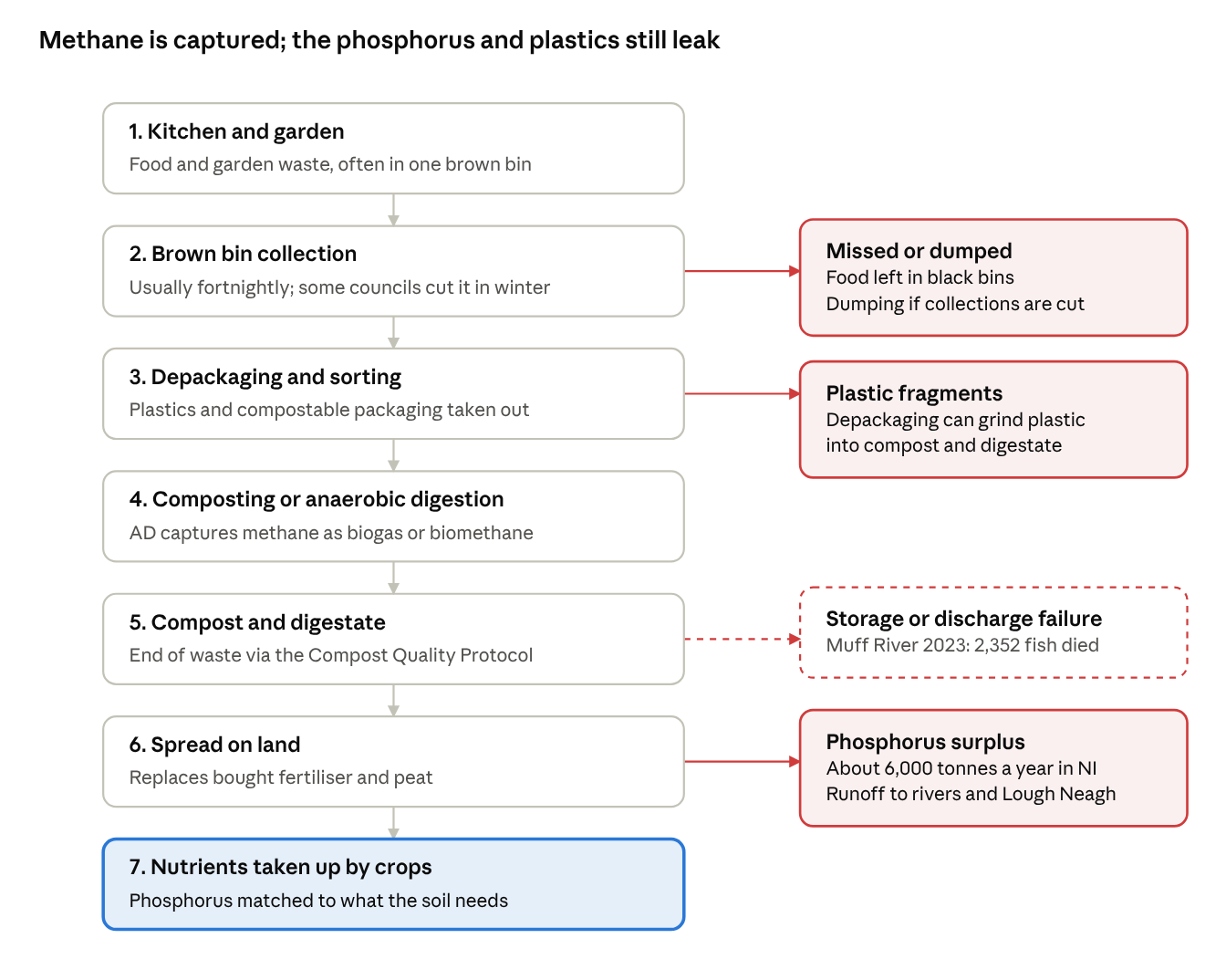
Policy has focused on the first four stages, getting food out of landfill and capturing its methane. The open leaks sit further down: plastic in the output, spills, and phosphorus spread where the soil already has too much.
Then and now (2023 to October 2026)
| Rule or instrument | 2023 | Now (with date) | What changed and why |
|---|---|---|---|
| NI Food Waste Regulations 2015 | Food businesses producing over 5kg a week must present it separately. No food waste to sewer. Councils must provide household food waste receptacles | Unchanged. The March 2024 consultation proposed separate food waste collection from all non-household premises; the response was still awaited on 14 Apr 2026 (Belfast City Council) | NI policy stalled while England and Wales moved ahead |
| England, Simpler Recycling | Announced 21 Oct 2023 (GOV.UK) | Workplaces from 31 Mar 2025; households from 31 Mar 2026; micro-firms from 31 Mar 2027 | A Conservative policy carried through by Labour. Delivery slipped where vehicles and revenue funding ran short |
| Wales, workplace recycling | Due to start | In force since 6 Apr 2024. Food waste banned from sewers at any amount (gov.wales, updated Apr 2026) | Wales extended its household approach to workplaces |
| Scotland, landfill ban on biodegradable municipal waste | Due end of 2025 | Applies from 31 Dec 2025; SEPA will not fully enforce it until 1 Jan 2028 (SEPA) | A shortfall in energy-from-waste capacity |
| NI waste strategy | Previous strategy only | Draft Rethinking Our Resources consulted on 15 Jan to 6 May 2026: 70% recycling by 2030, landfill capped at 10% by 2035 (DAERA) | The Climate Change Act (NI) 2022 sets the 70% duty. No numerical food waste target |
| Compost end-of-waste (England) | Compost Quality Protocol | Withdrawn 20 Oct 2025 and replaced by the Compost Resource Framework, with a plastics limit half the PAS 100 level (letsrecycle, 22 Oct 2025) | Concern about microplastics on farmland |
| Compost end-of-waste (NI) | Compost Quality Protocol | NIEA still lists the protocol as NI’s end-of-waste route (page updated 6 Feb 2025). The certification body agrees (CCS, 2026); GOV.UK’s withdrawal covers England | NI has not matched England’s tighter plastics limit |
| Peat in horticulture | Amateur sales ban promised for 2024 | No ban in England; legislation “when Parliamentary time allows” (29 Oct 2025). DAERA will consult on limiting retail sales (delivery plan, 22 Apr 2026) | Change of government and no parliamentary slot |
| Landfill methane | Falling | Waste was 3.8% of NI emissions in 2024, down 52.9% on the base year (NISRA/DAERA, 9 Jun 2026) | Diversion to energy recovery. Landfill tax rises by RPI from 1 Apr 2027, and applies in NI (Budget, 28 Oct 2026) |
Where the parties and governments stand (October 2026)
Every government agrees food waste must be collected separately. They split over who pays for garden waste, how fast councils must move, and whether to ban peat.
| Party or government | Position (dated) |
|---|---|
| UK Government (Labour) | Kept the 31 Mar 2026 household deadline with over £340m in capital funding (letsrecycle, 1 Apr 2026). Emma Hardy became circular economy minister in July 2026. The Circular Economy Growth Plan is delayed. Peat legislation has no date (29 Oct 2025). The Budget raised landfill tax by RPI from 1 Apr 2027. ADBA said it did not lift the biomethane cap (28 Oct 2026) |
| Conservatives (Badenoch) | Designed Simpler Recycling in government (Oct 2023). No published national position on reversing it found (searched 27 Oct 2026) |
| Reform UK (Farage) | Backs more recycling without detail; critical of decarbonisation (FCC report, 9 Apr 2026). No national garden or food waste position found |
| Liberal Democrats (Davey) | Local parties attack councils that miss food waste deadlines (1 Apr 2026). No national position on garden waste charges found |
| Green Party E&W (Polanski) | Local Greens defend weekly food waste collection sent to AD (20 May 2025). No national 2026 statement found |
| Scottish Government (Swinney) | Landfill ban from 31 Dec 2025 with soft enforcement to 2028; statutory household recycling code being co-designed (Mar 2025) |
| Welsh Government (ap Iorwerth) | Plaid’s 2026 manifesto would work with other UK nations to ban horticultural peat. Workplace recycling law stays |
| NI Executive / DAERA (Muir) | Draft strategy (15 Jan 2026) seeks more food waste capture. Funds slurry AD and compost through SULS, including £4m for NWP (19 Feb 2026). Will consult on retail peat sales |
| NI Department for the Economy | Said in April 2025 the market alone will not deliver biomethane; support scheme under consideration |
| NI parties | In Ards and North Down the DUP opposed monthly grey bins while Alliance, UUP, Greens and SDLP backed a trial (2020). Belfast City Council wants DAERA to fund new service costs (14 Apr 2026). No 2026 positions from Sinn Féin or TUV found (searched 27 Oct 2026) |
-
Charging. England let councils keep garden waste charges (Oct 2023). NI councils with a combined food and garden bin find a charge harder to apply. Mid Ulster’s first brown bin is free; a second costs £50 a year.
-
Pace. Wales and England have business duties. NI has kept its 2015 rules for over a decade.
-
Peat. Plaid and DAERA lean towards restricting sales. Westminster has a promise but no bill.
-
Reform has no stated waste position, so its councils’ choices are the only evidence.
Who decides what
Waste policy is devolved. Product rules touching the EU single market can still reach NI through the Windsor Framework.
| Instrument | Who decides | Whose approval is needed | Position in Northern Ireland |
|---|---|---|---|
| Food Waste Regulations (NI) 2015 | DAERA | NI Assembly | In force; food businesses over 5kg a week |
| NI waste strategy and targets | DAERA | Executive; Climate Change Act (NI) 2022 sets the 70% duty | Final strategy awaited |
| Garden waste charges | Each council | Council vote | No NI council found charging for a first brown bin (searched 27 Oct 2026) |
| Compost and digestate end-of-waste | NIEA | Voluntary protocols | NIEA still lists the protocol; its bespoke end-of-waste service has been paused since Feb 2025 |
| EU fertilising products (Reg. 2019/1009) | EU | EU co-legislators; NI Assembly scrutiny | Applies in NI under the Windsor Framework |
| EU food waste reduction targets (Directive 2025/1892) | EU | Member states | Apply in Ireland, not NI; NI suppliers to Irish retailers will feel them |
| Retail peat sales | Defra (England), DAERA (NI) | Parliament / Assembly | DAERA consultation committed by Dec 2027 |
Where the pillars compete
-
Revenue against fairness (E against S). Garden waste charges raise money and encourage home composting. They also hit households with gardens but little spare cash, and MPs heard that such charges fuel fly-tipping (Commons Library).
-
Methane capture against phosphorus (E against E). AD keeps food and slurry out of landfill and makes biomethane. But NI has a phosphorus surplus of about 6,000 tonnes a year (rePhoKUs 2020, cited by DAERA on 19 Feb 2026). Unless digestate is exported or processed, its phosphorus stays in the catchment. A digestate discharge killed 2,352 fish in the Muff River in November 2023.
-
Peat-free against clean compost (E against E). Compost from food and garden waste is the obvious peat substitute, but kerbside feedstock carries plastics. England halved its plastic limit in October 2025. The UK PFAS Plan (3 Feb 2026) flags sewage sludge as a route for PFAS into soils, and the same worry could reach compost.
-
Compostable packaging against contamination (E against E). Most UK food waste services reject compostable packaging, and UK EPR gives it the highest-fee red rating (Resource, 12 Aug 2026).
-
Fewer lorry miles against smells and dumping (E against S). ABC’s winter brown bin pilot (Dec 2024 to Mar 2025) aimed to cut mileage, fuel and emissions. Where food shares the bin, less frequent collection risks smells and misuse.
What it means for Northern Ireland firms and councils
-
Food manufacturers. The 5kg threshold and the sewer ban apply now. Expect a wider duty if DAERA follows its 2024 proposal.
-
AD gate fees. Food waste competes with slurry, silage and processing residues. NIRO closed in 2017, so gate fees will reflect the squeeze on feedstock and digestate outlets. The UK Budget did not lift the biomethane cap, ADBA said (28 Oct 2026).
-
Packaging contamination. Plastic in food waste lowers compost and digestate quality. Depackaging lines help but can grind plastic into fragments.
-
Councils. The 70% duty and 10% landfill cap need more organics captured. Winter cuts save little and carry a fly-tipping risk. Landfill tax rises by RPI from 1 Apr 2027, so food left in black bins costs more to dispose of (Budget, 28 Oct 2026).
-
Data gaps. No central register counts NI AD plants; estimates range from 46 to 84 (RaISe, 16 Mar 2026).
-
Compost buyers. NI still works to the older protocol and plastics limit, so check certification and plastic content.
Practical examples
-
Slurry and food waste AD, Dunmurry. On 19 February 2026 DAERA awarded Natural World Products £4m to build NI’s first high-solids AD plant. It will digest slurry solids with food and garden waste, and blend phosphorus-rich solids into PAS 100 compost (DAERA).
-
Digestate pollution, Muff River. In March 2026 the Loughs Agency secured a conviction against an AD operator for a November 2023 discharge that killed 2,352 fish. The penalty was the £5,000 statutory maximum plus £2,160 costs (Derry Now, 26 Mar 2026).
-
Winter collections, ABC. Armagh, Banbridge and Craigavon moved brown bins to four-weekly collection from mid-December 2024 to the end of March 2025. The council said winter bins hold much less garden waste (Armagh I, 2 Dec 2024).
-
Second-bin charge, Mid Ulster. Mid Ulster collects one brown bin per property and charges £50 a year for a second (Mid Ulster Council, checked 28 Oct 2026).
-
England’s food waste rollout. About three-quarters of English councils were ready for weekly food waste on 31 March 2026. Another 31 had transitional agreements, some running to 2043, despite over £340m in capital funding (letsrecycle, 1 Apr 2026).
Recommendations
-
DAERA: publish its response to the 2024 consultation, with a date for business food waste duties. Firms need lead time, and England and Wales already have one.
-
NIEA: say whether NI will update the compost protocol, and restore its end-of-waste service. Clear rules protect the market for peat substitutes.
-
DAERA: match England’s tighter plastics limit, with a transition period. NI compost should not become where GB rejects end up.
-
DAERA and DfE: link any biomethane support to phosphorus export or recovery from digestate. Otherwise climate policy adds to Lough Neagh’s nutrient load.
-
Councils: keep fortnightly brown bin collections all year where food shares the bin. The savings are small and the public health risk is real.
-
Councils: offer subsidised home composters before considering a garden waste charge.
-
Food manufacturers: audit what goes into food waste and remove packaging at source. Cleaner feedstock means lower gate fees.
-
DAERA: run the retail peat consultation in 2027 alongside a supply plan for quality compost. A ban without supply pushes buyers to imported peat.
Sources
-
More than 70 councils not ready for food waste collections, letsrecycle (25 Feb 2026)
-
Council contemplate reducing winter bin collections, Derry Now (21 Apr 2026)
-
Rethinking Our Resources consultation, DAERA (15 Jan–6 May 2026)
-
Minister sets out circular economy opportunities, DAERA (15 Jan 2026)
-
DAERA consultation report, Belfast City Council (14 Apr 2026)
-
Written statement on Simpler Recycling, UK Parliament (23 Oct 2023)
-
Changes to workplace recycling, gov.wales (updated Apr 2026)
-
UK Government plans to end peat sales, Peat-free Partnership (31 Oct 2025)
-
End-of-waste compliance by nation, Compost Certification Scheme (2026)
-
What the PFAS Plan means for industry, Envirotec (12 Feb 2026)
-
Explanatory memorandum on Reg. 2024/2516, NI Assembly (14 Oct 2024)
-
FCC report: Reform UK rise creates uncertainty, letsrecycle (9 Apr 2026)
-
86% of councils on track for Simpler Recycling in 2026, letsrecycle (1 Apr 2026)
-
Loughs Agency secures conviction after Muff River fish kill, Derry Now (26 Mar 2026)
-
Budget 2026 Overview of Tax Legislation and Rates, HM Treasury and HMRC (28 Oct 2026)
-
Live sector reactions to the Autumn Budget 2026, letsrecycle (29 Oct 2026)
Robert J. Park is an independent environment, carbon and public-affairs consultant based in Larne, Northern Ireland. He helps firms and public bodies measure their carbon and make their case on policy.
Agree or disagree? Get in touch on LinkedIn or WhatsApp @robertjpark.