
What’s the beef with Northern Ireland?
Northern Ireland’s beef supply is moving from the suckler herd to the dairy herd. Price, retail specification and public money all reward cattle that finish faster. Phosphorus, not only carbon, is the limit that bites first. And for NI the carbon question is speed and system, not grass against grain. This piece follows beef from the calf to the plate and on to the hide, the offal and the slurry, with the dairy herd that now breeds almost half of it.
General information as at 21 November 2026, not legal or financial advice. Claims I have not checked against a primary source are in italics. The full briefing, with every section, table and source, is a 13-page PDF: download the full briefing (PDF). This page is the accessible version.
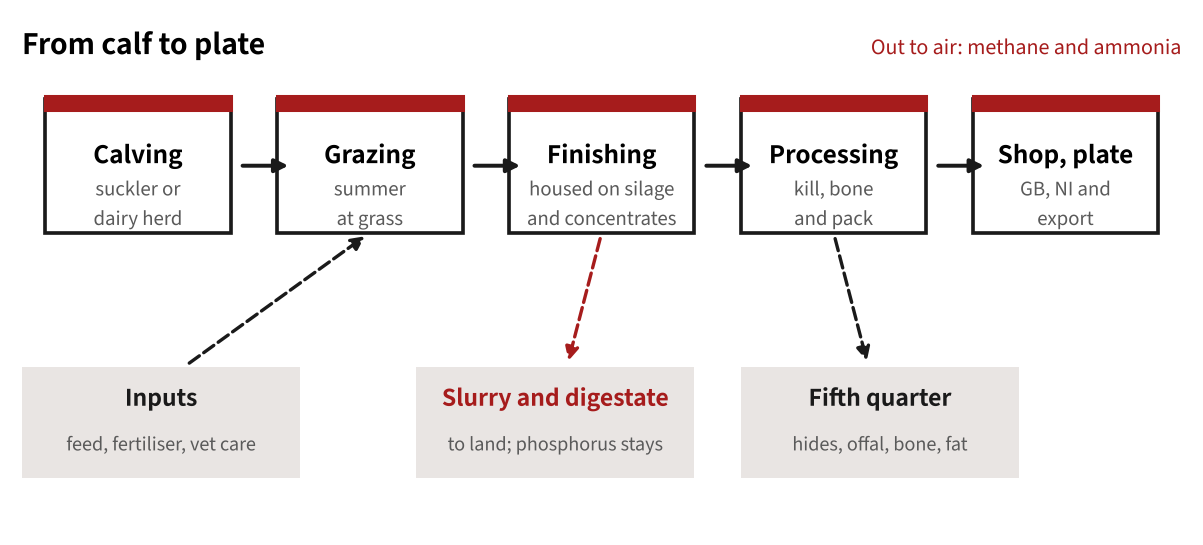
Key findings
- Two herds, one supply. There were 213,744 beef cows in June 2025, down 5%, and a record 330,673 dairy cows, up 2% (DAERA June census, 11 December 2025). Almost half of beef-sired calves (48.5%) were dairy-bred in 2025 (Livestock and Meat Commission analysis, as reported).
- Record prices, eased since. Finished cattle averaged £6.33 a kilo in 2025, up 32% (DAERA, 20 August 2026). GB steers ran about 26p a kilo above NI in late October 2026.
- Public money matters most on the hills. Hill cattle and sheep farms averaged £24,298 in 2024/25; dairy farms £118,784.
- The law sets the pace. The Climate Change Act (Northern Ireland) 2022 requires a 48% cut in net emissions by 2030. Agriculture was 31.4% of NI emissions in 2024 (DAERA, 9 June 2026).
- Phosphorus is the binding limit. NI farming ran a surplus of 8,729 tonnes in 2024, and agriculture is the largest source of phosphorus reaching Lough Neagh.
- Speed and system decide the footprint. Faster growth and younger slaughter cut lifetime methane. How much grass is in the diet matters less than how long the animal lives.
Two herds
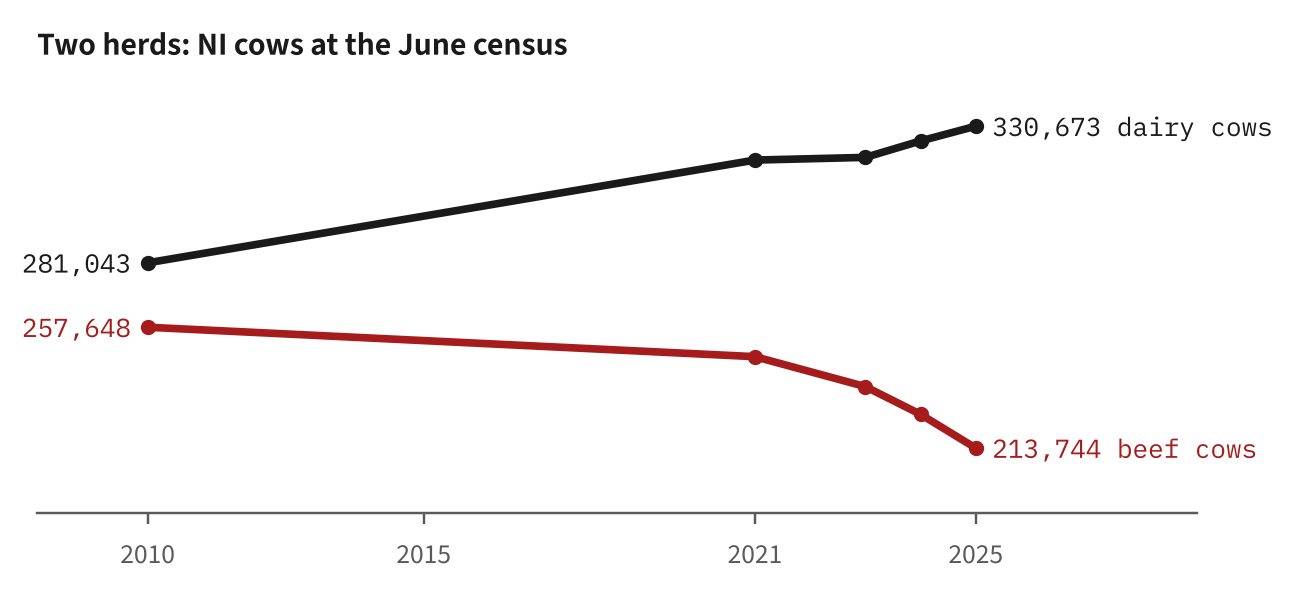
The suckler herd carries the hills, the hedges and the highest footprint per kilo. The dairy herd supplies a growing share of beef calves, as sexed semen keeps dairy heifers for milk and puts beef sires, mostly Aberdeen Angus, on the rest. Suckler and dairy-bred beef need different policy.
Carbon: speed and system, not grass against grain
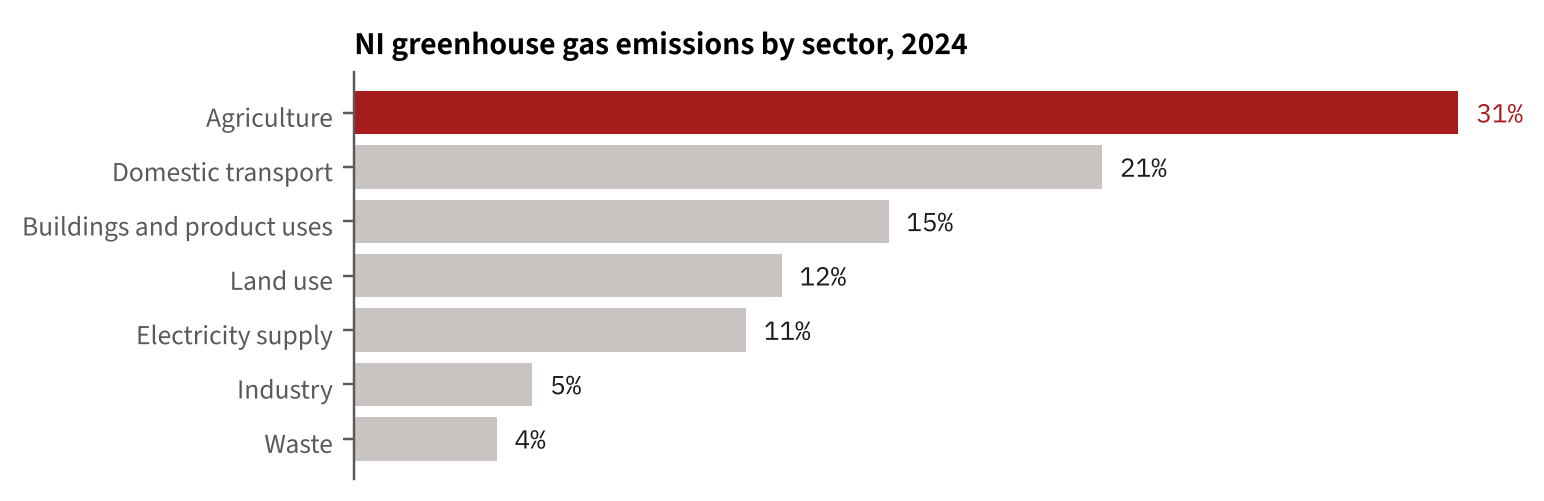
Methane was 29.5% of NI emissions in 2024, mostly from cattle rumens. Studies from Wales, England, Ireland, the USA, Australia and Brazil mostly find that grain or concentrate finishing has the lower footprint per kilo, because cattle grow faster and are killed younger. Grass closes the gap, and can win, when soil carbon, land that can grow nothing else, or the land cleared to grow imported feed is counted.
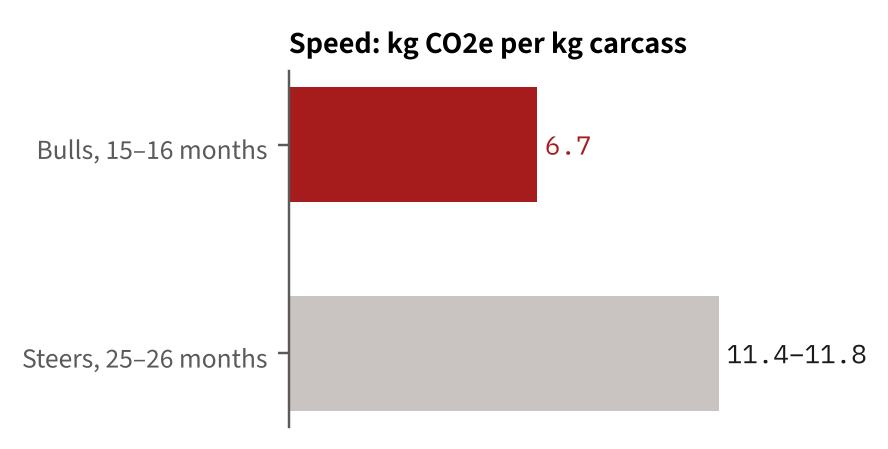
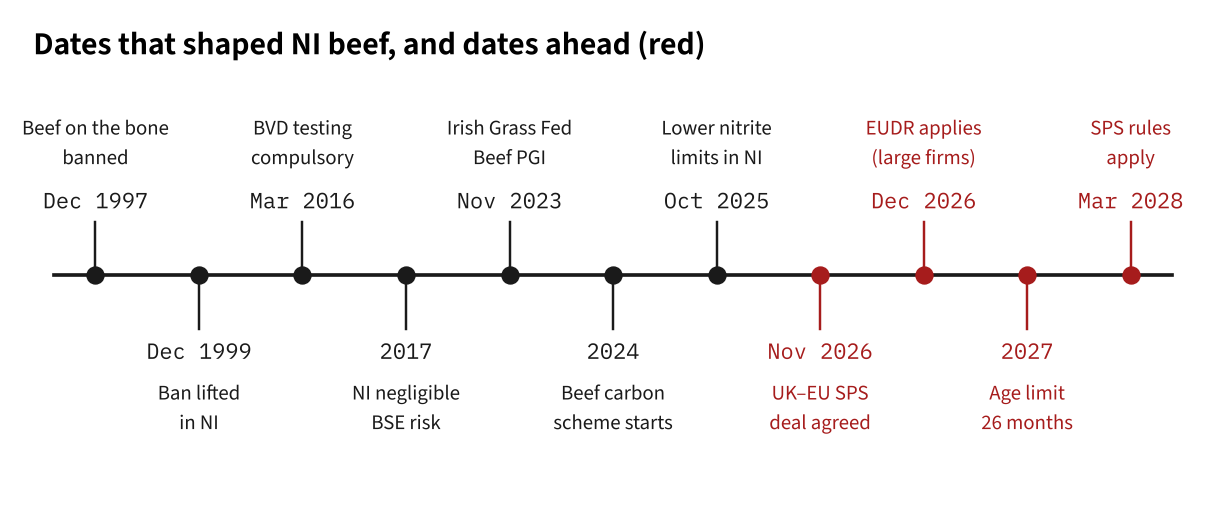
NI cattle are neither feedlot nor pure grass: summer grazing, winter silage and bought concentrates. That is the logic of DAERA’s Beef Carbon Reduction Scheme, which pays £75 a head for prime cattle killed under an age limit that falls from 30 months in 2024 to 26 months in 2027. The Suckler Cow Scheme, from 1 April 2025, pays for earlier first calving and shorter calving intervals. Both are paid for out of farmers’ area payments, and nothing is published for beef after 2027.
Feed and soy
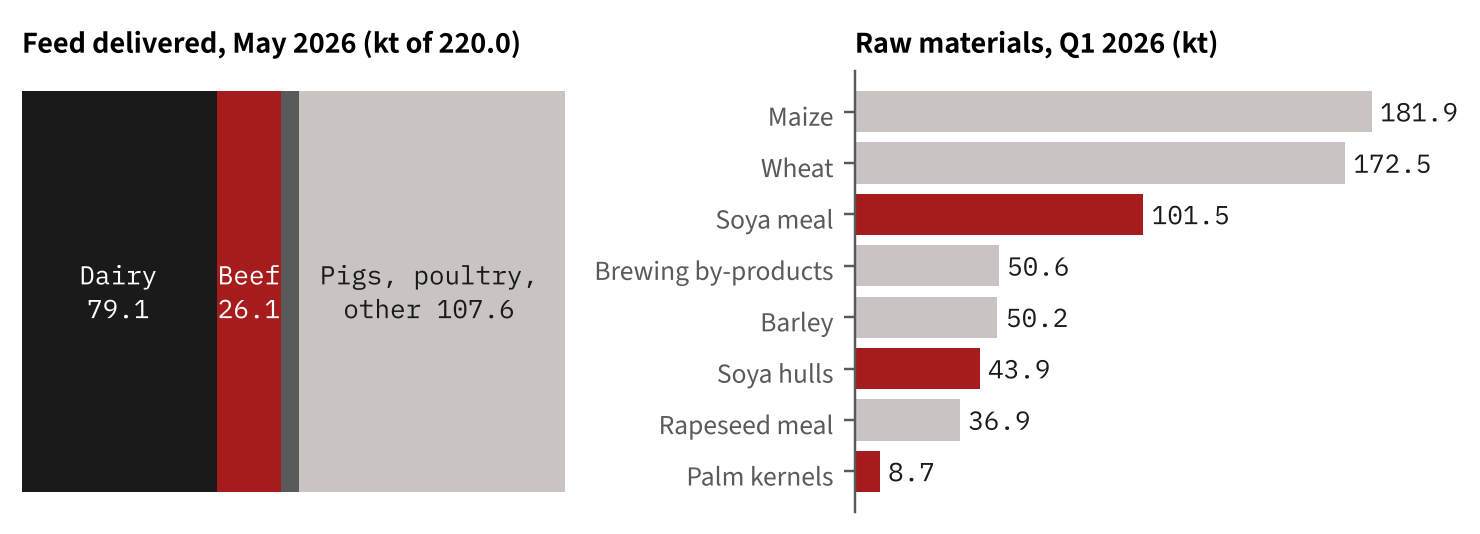
Cattle took 112.7 of the 220.0 thousand tonnes of feed delivered in May 2026; beef cattle 26.1. NI compound feed used 101.5 thousand tonnes of soya meal in the first quarter of 2026. DAERA does not split raw materials by livestock type, so there is no honest figure for soy in beef. What matters more than the tonnage is where it grew. The EU Deforestation Regulation applies in NI, with DAERA as competent authority for cattle, soya and palm, from 30 December 2026 for large and medium operators (GOV.UK, updated 11 November 2026).
Phosphorus and Lough Neagh
Agriculture is the largest source of phosphorus reaching Lough Neagh in DAERA’s provisional model (July 2024). An anaerobic digester turns slurry into gas, but every kilogram of phosphorus that goes in comes out in the digestate. It eases the surplus only if nutrients are stripped out and exported. The 2027–2030 Nutrients Action Programme may decide herd size before carbon does.
On the farm
- Grass. 2025 was a strong grass year. GrassCheck recorded 10.8 to 12.9 tonnes of dry matter a hectare (press report of AgriSearch data).
- Husbandry. Double ear tags and birth notification within set periods; castration, disbudding and dehorning limits under SR 2012/153.
- Health. BVD tissue-tag testing compulsory since 1 March 2016, with herd restrictions since 1 February 2025. Bluetongue BTV-3 vaccination under a general licence from 15 April 2026. Bovine TB herd incidence fell below 10% in December 2025; wider blood testing began on 29 June 2026.
- Breeds. Limousin and Charolais dominate suckler sires; Aberdeen Angus dominates dairy-beef sires. Native breeds such as the Irish Moiled and Dexter finish slowly on grass and will tend to miss the scheme’s age limit.
The whole animal, and the kitchen
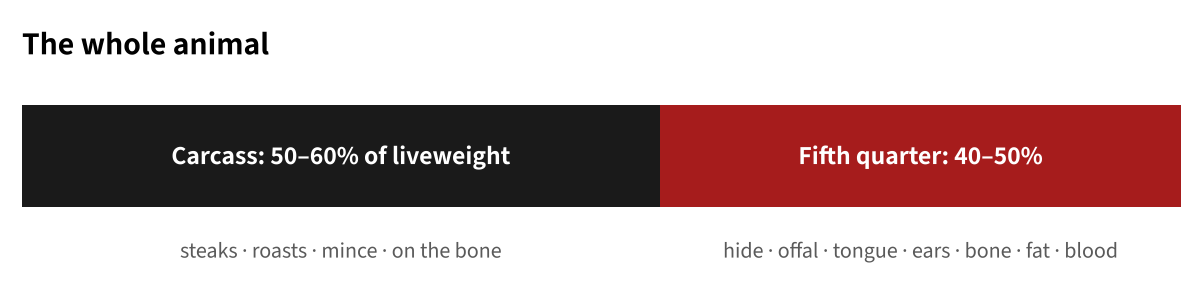
The farmer is paid on the carcass. The rest, the fifth quarter, is sorted by risk under the animal by-products rules. Hide values have fallen sharply, and small abattoirs that once sold hides now pay to dispose of them. Offal, tongue and cheek are mostly exported or go to pet food. Scalded ears are an edible co-product, though most become dog chews. Pressed tongue is brined, simmered, skinned and pressed, and NI curers now work to the lower EU nitrite limits that have applied here since 9 October 2025.
Beef on the bone was banned in NI from 16 December 1997 (SR 1997/540) and allowed again from 17 December 1999. UK households wasted 6.4 million tonnes of food and drink in 2021/22 (WRAP); leftover roast and stew make hash, cottage pie and stock, and bones make broth.
The dairy herd: milk, butter and cheese
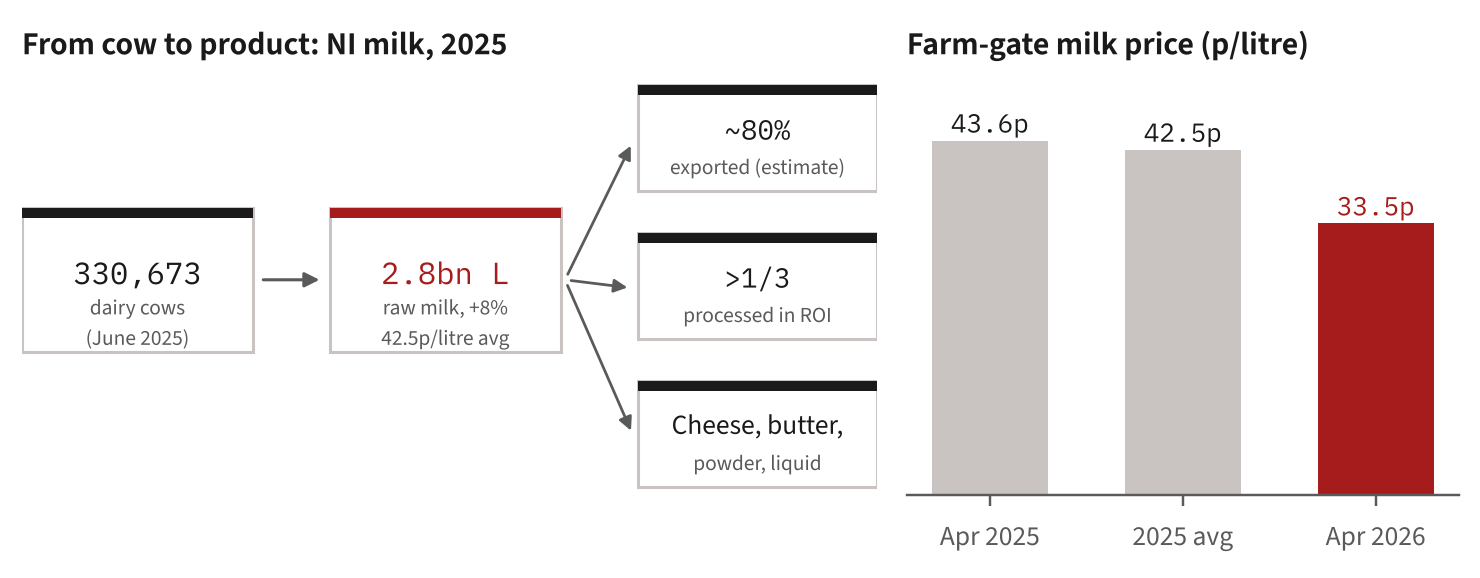
NI produced a record 2.8 billion litres of milk in 2025, up 8%, at an average farm-gate price of 42.5p a litre. Dairying was the largest farm output at £1.2 billion. The price fell to 33.45p in April 2026, 10.19p lower than a year earlier, yet output kept rising (DAERA milk statistics). About 80% of NI dairy output is exported (AHDB analyst estimate), and over a third of NI milk is processed in the Republic of Ireland (safefood).
Most of it becomes cheddar, butter and milk powder. Roughly 10 litres make a kilo of cheddar; about 20 make a kilo of butter. NI’s artisan makers include Young Buck, a raw-milk blue first made in Newtownards in 2013, Kearney Blue, Dart Mountain’s Sperrin Blue, Fivemiletown’s Causeway Cheddar, Ballylisk Triple Rose and Abernethy butter. More dairy cows mean more slurry and phosphorus in the same catchment beef farms share.
Raw milk at the farm gate
Raw, unpasteurised cows’ milk for drinking is legal in NI, but only from a registered producer, direct to the consumer: at the farm gate, in farmhouse catering, at a farmers’ market by the farmer, by pre-arranged delivery or collection, from a milk-round vehicle, or in a farm shop on the holding. Shops off the farm have been barred since 1985 (Food Hygiene Regulations (NI) 2006, Schedule 6; FSA guide to the law in NI, November 2025). Scotland has banned all raw milk sales since 1983.
- Who checks. DAERA’s Agri-food Inspection Branch registers and inspects for the FSA, normally twice a year. A new seller must give DAERA and the council 28 days’ notice and cannot sell before an inspection.
- TB is the catch. The milk must come from a herd that is officially TB free and brucellosis free. Lose that status and sales stop. With herd TB incidence around 10%, that is a real risk in NI.
- Strict standards and a warning label. No Salmonella, Campylobacter or STEC in 25 ml, low bacterial counts, and a label saying the milk has not been heat-treated and that children, pregnant women, older people and anyone unwell should not drink it.
- Hard to find. About 135 producers were registered across England, Wales and NI in 2023 (safefood). I found no current count for NI.
- The benefits, honestly. Buyers value the taste, the cream line and a direct link to the farm; the farmer gets a far better price per litre. Some European studies of farm children link unboiled farm milk with less asthma and allergy, but they do not show cause. The FSA treats raw milk as a high-risk food and says no health benefit is established; its scientific advisers rate raw cows’ drinking milk as medium risk per portion.
For a dairy farmer it is a niche: a small, TB-free, very clean herd near a town can sell at a premium, but testing, labelling and the TB risk make it a side line, not a market for 2.8 billion litres.
UK and EU: now and later
| Matter | Now (21 November 2026) | Later |
|---|---|---|
| UK–EU SPS agreement | Agreed at the summit on 20 November 2026; legal text and UK legislation awaited | GB to align with EU food and feed rules from 1 March 2028 |
| Nitrites in cured beef | EU limits in NI since 9 October 2025 | GB expected to align |
| EU Deforestation Regulation | Applies in NI from 30 December 2026 (large and medium), 30 June 2027 (micro and small) | A Commission act of 13 July 2026 takes hides and leather out and adds frozen tongues from 30 December 2027; check Official Journal publication |
| Farm support | Beef Carbon Reduction Scheme 2024–2027; Suckler Cow Scheme since 1 April 2025 | Nothing published for beef after 2027 |
What this means
- The question for NI is speed and system, not grass against grain. Younger slaughter and better calving cut lifetime methane, which is why the schemes pay for them.
- Suckler and dairy-bred beef need separate policy. The suckler herd carries the hills and the highest footprint per kilo; native and hill cattle will tend to miss a pure age limit.
- Phosphorus may decide herd size before carbon does.
- The money question is 2028. Both beef schemes are funded from area payments, and nothing is published beyond 2027.
These points are my analysis, not official statistics. For the argument that cutting NI’s herd while demand holds steady just moves emissions elsewhere, see Fewer cows in Antrim, more beef from Brazil?.
The full briefing
The 13-page PDF adds markets and specification, the grass-or-grain evidence table, methane and Bovaer, vaccines, breeds, offal, ears and tongue curing, beef on the bone, menus, leftovers, the dairy herd, raw milk at the farm gate, structural issues, opportunities and risks, and a list of what is not yet verified. It was reviewed by two panels: a fact-check against primary sources and a practitioner panel.
This is general information as at 21 November 2026, not legal or financial advice. Created with assistive technology including AI and re-checked against the official sources listed.