
Antimony: the critical mineral nobody has heard of
Element 51 is in the plastic of your bottle, the battery in your car and the glass on a solar panel. Most of it comes from one country.
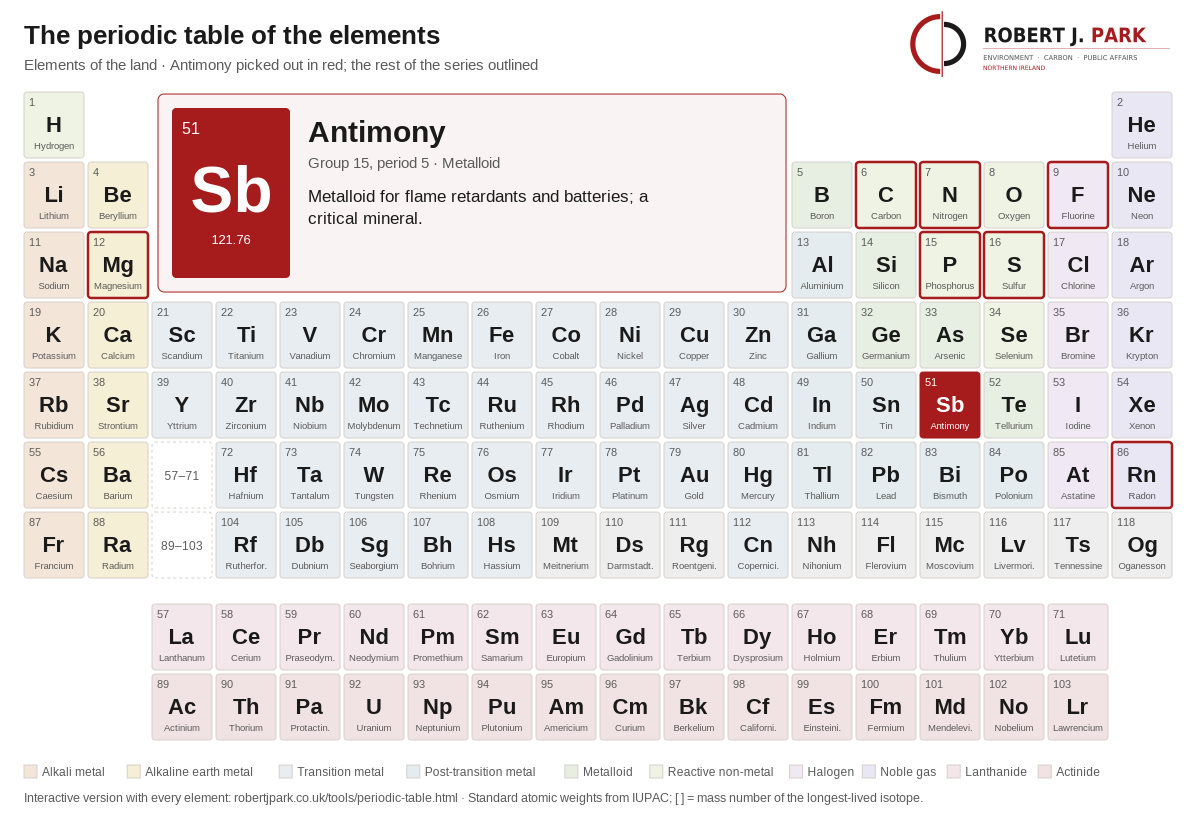
Antimony is a brittle, silvery metalloid that most people have never heard of. Industry has. It makes plastics and fabrics harder to burn, hardens the lead in batteries and bullets, and clears bubbles from glass, including the glass on solar panels.
It is also on the UK’s critical minerals list: important to the economy and at high risk of supply disruption.
The element in one minute
- Number 51, group 15, period 5. A metalloid, sitting below arsenic, which it resembles chemically.
- Main ore: stibnite (antimony sulfide), often found with gold.
- Supply: mining and refining are concentrated in China, with Russia and Tajikistan next.
Climate
Antimony has no greenhouse gas. Its climate link is supply. It is used in:
- Solar glass, as a fining agent that removes bubbles.
- Lead-acid batteries, still used for vehicle starting and back-up power.
- Flame retardants in cables and insulation, both in demand as buildings and grids electrify.
A shortage of antimony can therefore slow parts of the energy transition.
Soil and land
Antimony is a contaminant worth testing for at:
- Shooting grounds and ranges, where lead shot and bullets contain antimony.
- Busy roads, where brake pads containing antimony sulfide wear into roadside dust and drain sediment.
- Battery recycling sites, scrap yards, smelters and old landfill.
In soil, antimony usually binds to iron and manganese oxides, but it is more mobile in some conditions than lead. Its toxicity is similar in kind to arsenic’s, though lower.
Agri-food
Antimony does not feature in farming directly. PET bottles and food trays are made with an antimony catalyst, and very small amounts can migrate into contents, more so when warm. Food contact rules limit this.
Atmosphere
Antimony reaches the air as fine dust from smelting, coal and waste burning, and brake wear. It is a minor part of urban particulate pollution.
Why it matters
In September 2024 China began licensing exports of antimony ores, metal and oxides. In December 2024 it banned exports to the United States (MOFCOM Announcement No. 46 of 2024), then suspended that ban from 9 November 2025 to 27 November 2026 (Announcement No. 72 of 2025), keeping the wider licensing in place. As at 21 November 2026, China had published no extension of that date, although it has said the wider US–China arrangement runs to 10 January 2027.
For UK and Irish manufacturers, that means flame-retardant plastics, batteries and specialist glass can face supply risk well beyond their own sector. It is a question worth asking of suppliers.
The rules (as at 21 November 2026)
- Classification: diantimony trioxide is classified as suspected of causing cancer (Carc. 2, H351) under CLP, following the ECHA Committee for Risk Assessment opinion of 3 July 2009.
- Workplace: the workplace exposure limit for antimony and its compounds (except stibine) is 0.5 mg/m³ (EH40).
- Critical minerals: antimony was on the UK’s 2022 list and remains critical in the 2024 assessment.
- Contaminated land: antimony is assessed case by case. It is a contaminant to include where site history suggests it.
Safety and handling
COSHH applies to antimony and its compounds. The main workplace risks are dust and fume (from smelting, battery and alloy work) and stibine gas.
| Form | Classification (CLP) |
|---|---|
| Antimony (metal) | No harmonised CLP entry for the massive metal; suppliers classify powder by its hazards (check the safety data sheet). |
| Antimony compounds (group entry, with listed exceptions) | Acute Tox. 4 H302 + H332 (harmful if swallowed or inhaled); Aquatic Chronic 2 H411. Harmonised (CLP Annex VI). |
| Diantimony trioxide (Sb₂O₃) | Carc. 2 H351 (suspected of causing cancer). Harmonised (CLP Annex VI). |
| Substance | Workplace exposure limit (EH40/2005) |
|---|---|
| Antimony and compounds except stibine (as Sb) | 0.5 mg/m³ LTEL |
| Stibine | No WEL in EH40 (the antimony limit excludes it); keep exposure as low as reasonably practicable |
| UN number | Proper shipping name | Class |
|---|---|---|
| UN2871 | Antimony powder | 6.1 |
| UN2676 | Stibine | 2.3 (2.1) |
| UN1733 | Antimony trichloride | 8 |
| UN1730 | Antimony pentachloride, liquid | 8 |
Risks of the element itself. Solid antimony is of low hazard to handle. Its dust and fume irritate the lungs and skin (‘antimony spots’), and long exposure to the trioxide dust is a suspected cause of lung cancer. Stibine gas is acutely toxic.
Classification and limits change. Always work from the supplier’s current safety data sheet and your own COSHH assessment.
Compounds you will meet
| Where you meet it | Compound | Why it matters |
|---|---|---|
| Nature | Stibnite (Sb₂S₃) | the main ore |
| Antimonate and antimonite ions | the mobile forms in soil water | |
| Manufacturing | Antimony trioxide (Sb₂O₃) | flame-retardant synergist; PET catalyst; glass fining |
| Lead–antimony alloys | battery grids, cable sheathing, shot | |
| Antimony sulfide | friction modifier in brake pads; match heads | |
| Sodium antimonate | clarifying agent in glass, including solar glass | |
| Climate | No antimony greenhouse gas | its climate link is supply: solar glass, storage batteries and grid equipment |
| Flame retardants in insulation and cables | part of the building and electrification supply chain |
What this means
- For manufacturers: map where antimony sits in your bill of materials: flame-retardant plastics, batteries, glass, solder. Ask suppliers where it comes from.
- For site investigators: add antimony to the suite at ranges, road depots, scrap and battery sites.
- For policy: critical minerals are not only lithium and rare earths. The small, cheap, invisible ones can stop a production line too.
Sources
- GOV.UK, Critical minerals technical annex (November 2025) and British Geological Survey, UK 2024 Criticality Assessment (28 November 2024).
- ECHA Committee for Risk Assessment, Opinion on the harmonised classification of diantimony trioxide (3 July 2009).
- Ministry of Commerce of the People’s Republic of China, announcements on antimony export controls (effective 15 September 2024), No. 46 of 2024 (December 2024, US prohibition) and No. 72 of 2025 (9 November 2025, suspension to 27 November 2026).
- HSE, EH40/2005 Workplace exposure limits (4th edition, January 2020).
- Regulation (EC) No 1272/2008 (CLP), Annex VI.
- UNECE, ADR 2025.
All sources checked 21 November 2026.
Robert J. Park is an environment, carbon and public affairs consultant based in Larne, Northern Ireland. Download the briefing, *Antimony* (PDF), with the full periodic table, the safety panel and the sources. This is one of eight learning briefings on the elements that shape climate, soil, land, agri-food and the atmosphere; the others are linked from the interactive periodic table. This is general information as at 21 November 2026, not legal, safety or agronomic advice. AI was used to lay out this document and to generate leads from the consultant’s research, knowledge and questioning; figures were checked against the official sources listed.