Focus on Food & Drink Processing · 24 October 2026
A £7bn sector, half of it sold to GB. New rules land within twelve months.
Feeding the UK from Northern Ireland: how processors can keep their markets as deforestation, packaging and carbon rules arrive.
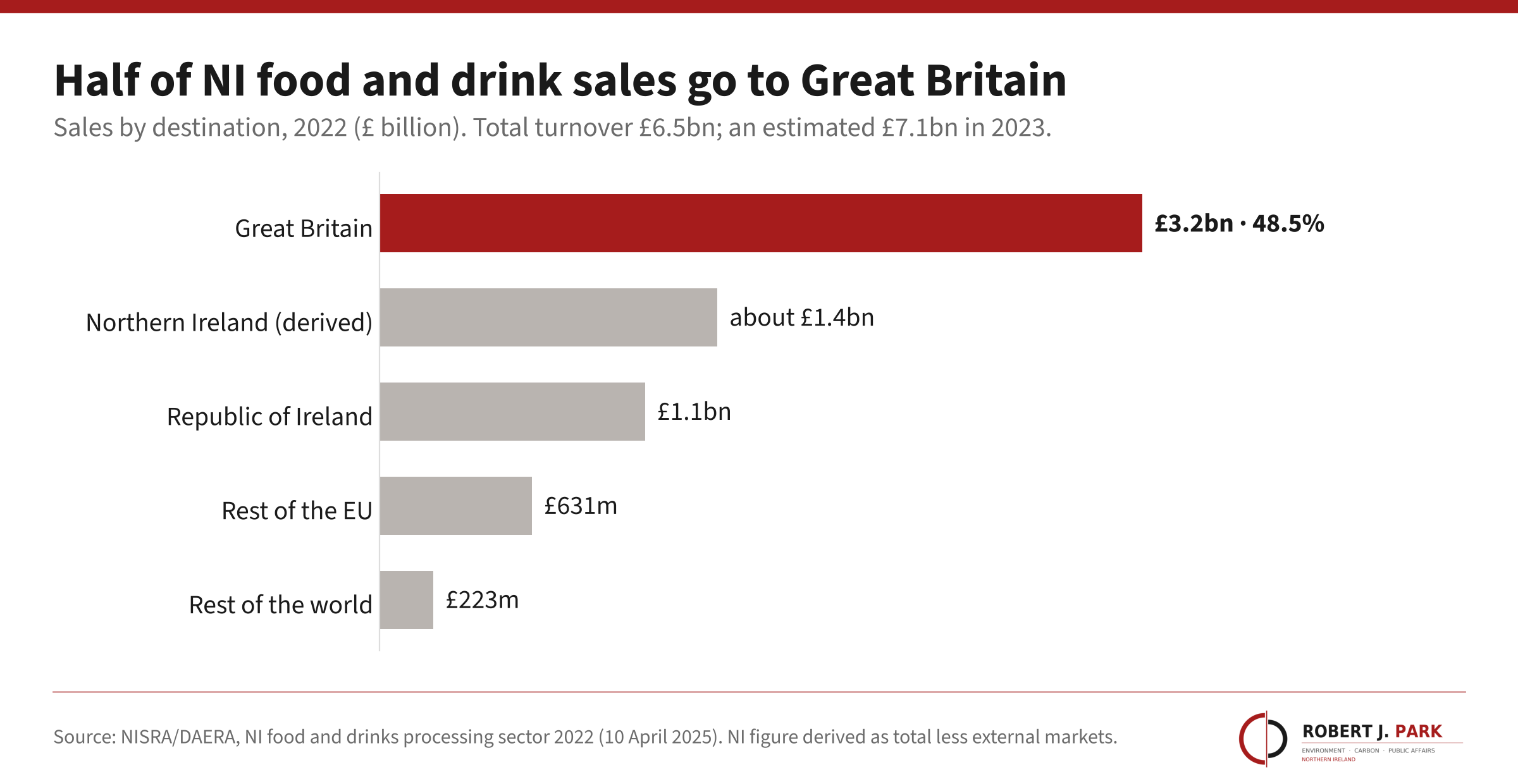
Northern Ireland's food and drink processors turned over £6.5bn in 2022 and an estimated £7.1bn in 2023, with almost half of their sales going to Great Britain. Their own emissions are falling: food and drink is one of the main reasons NI industry has cut its emissions by more than two-thirds since 1990. The pressure now comes from customers and new rules. Retailers want supplier carbon data, EU deforestation rules apply from 30 December, packaging fees are in their second year and a deposit return scheme starts in October 2027.
Where emissions sitIndustry has cut deep, and food and drink led the way
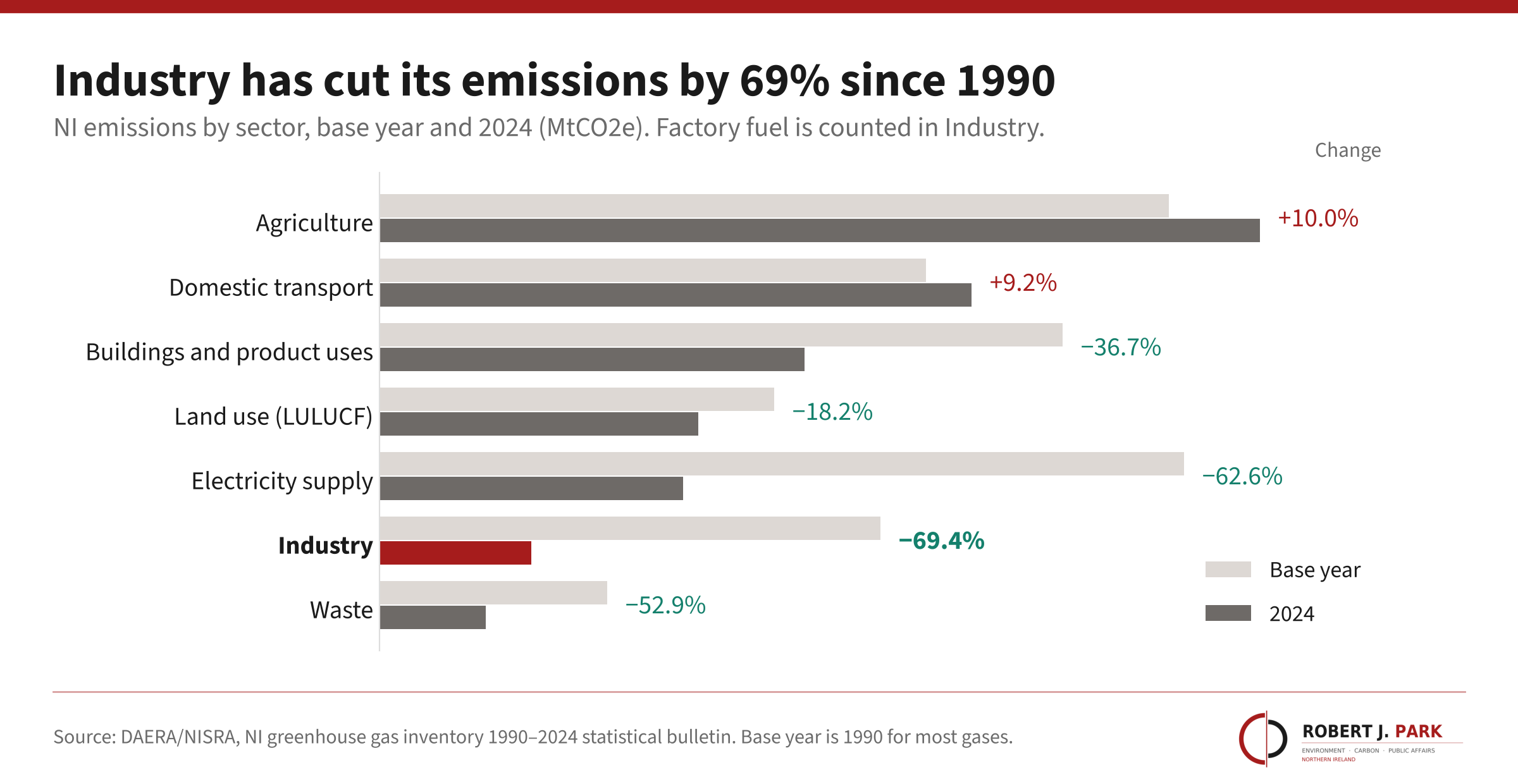
In the NI greenhouse gas inventory, factory fuel, industrial processes and industrial refrigeration sit in the Industry sector: 1.0 MtCO2e in 2024, down 69% since 1990. DAERA names food and drink, chemicals and cement as the largest long-term reductions, and lower fuel use in food and drink as one reason emissions fell again in 2024.
That figure is only part of a processor's footprint. Electricity is counted under electricity supply, and the largest share usually sits upstream in milk, meat, grain and feed, which the inventory counts under agriculture.
Scopes 1, 2 and 3The farm is in your footprint
Scope 1 is gas, oil and LPG for boilers, ovens and steam, plus refrigerant leaks. Scope 2 is bought electricity, mostly for refrigeration, compressed air and motors. Scope 3 is everything bought in and sent out: raw materials, packaging, haulage and waste.
For a dairy, meat or poultry processor, raw materials are usually by far the largest part. That links processors directly to the farm figures in last week's Focus on Agriculture: each kilogram of NI milk now carries 40% less carbon than in 1990, and that gain shows up in every dairy's Scope 3.
MarketsCustomers ask before regulators do
Great Britain took 48.5% of sales in 2022, about £3.2bn. The Republic of Ireland took £1.1bn and the rest of the EU £631m. Large UK retailers increasingly ask suppliers for emissions data and reduction targets for their own reporting.
The EU has narrowed its sustainability reporting rules (CSRD): they now apply only to groups with more than 1,000 employees and €450m turnover, and those groups can ask less of suppliers with fewer than 1,000 staff. Most NI processors will still be asked for data, but for less of it.
New rulesDeforestation, packaging, deposits and food waste
- EU deforestation rules (EUDR). From 30 December 2026, the EU Deforestation Regulation applies in NI to medium and large businesses, and from 30 June 2027 to most micro and small ones. It covers cattle, cocoa, coffee, palm oil, rubber, soya and wood, and products made from them, including some pallets and cartons. The business that first places a product on the NI market needs due diligence. The UK Government's own example is an NI meat processor importing Brazilian beef. Feed mills buying soya meal and confectioners buying cocoa are also in scope. DAERA enforces for cattle, cocoa, coffee, palm oil and soya.
- Packaging EPR. Year two of Extended Producer Responsibility for packaging is under way. PackUK expects to recover about £1.56bn from producers in 2026/27, with fees recalculated in November.
- Deposit return. NI's deposit return scheme for drinks containers goes live in October 2027. It covers PET plastic, steel and aluminium containers from 150ml to 3 litres and is run by UK Deposit Management Organisation Ltd. Drinks producers should follow UK DMO guidance on registration and labelling now.
- Food waste. Under the Food Waste Regulations (NI) 2015, businesses producing more than 5kg of food waste a week must present it for separate collection and must not put it down the drain.
DrinksThree rules meet in the bottle
NI drinks makers face three changes at once, and soft drinks feel all of them.
- Sugar levy. From 1 January 2028 the Soft Drinks Industry Levy will start at 4.5g of added sugar per 100ml, down from 5g, and will cover milk-based and milk-alternative drinks for the first time. Drinks with 4.5g to 7.9g will pay 19.4p a litre; drinks with more sugar will pay 25.9p.
- Deposit return. From October 2027, PET plastic, steel and aluminium containers from 150ml to 3 litres carry a deposit. Glass is not in the NI scheme, so the choice of container now affects both cost and paperwork.
- Packaging fees. Producer fees under packaging EPR are charged by weight and material, so heavy containers carry more of the fee.
A drinks maker that plans reformulation, container choice and packaging fees together will spend less than one that deals with them one at a time.
WaterLough Neagh keeps nutrients in the spotlight
Algal blooms on Lough Neagh have made phosphorus and water quality a public issue. Farm phosphorus surpluses have already fallen by 40% since 1991. Processors are large water users, and those with discharge consents are part of the same picture: effluent quality, water use and cost belong in the same plan as energy and carbon.
Policy and deadlinesSeven dates in fourteen months
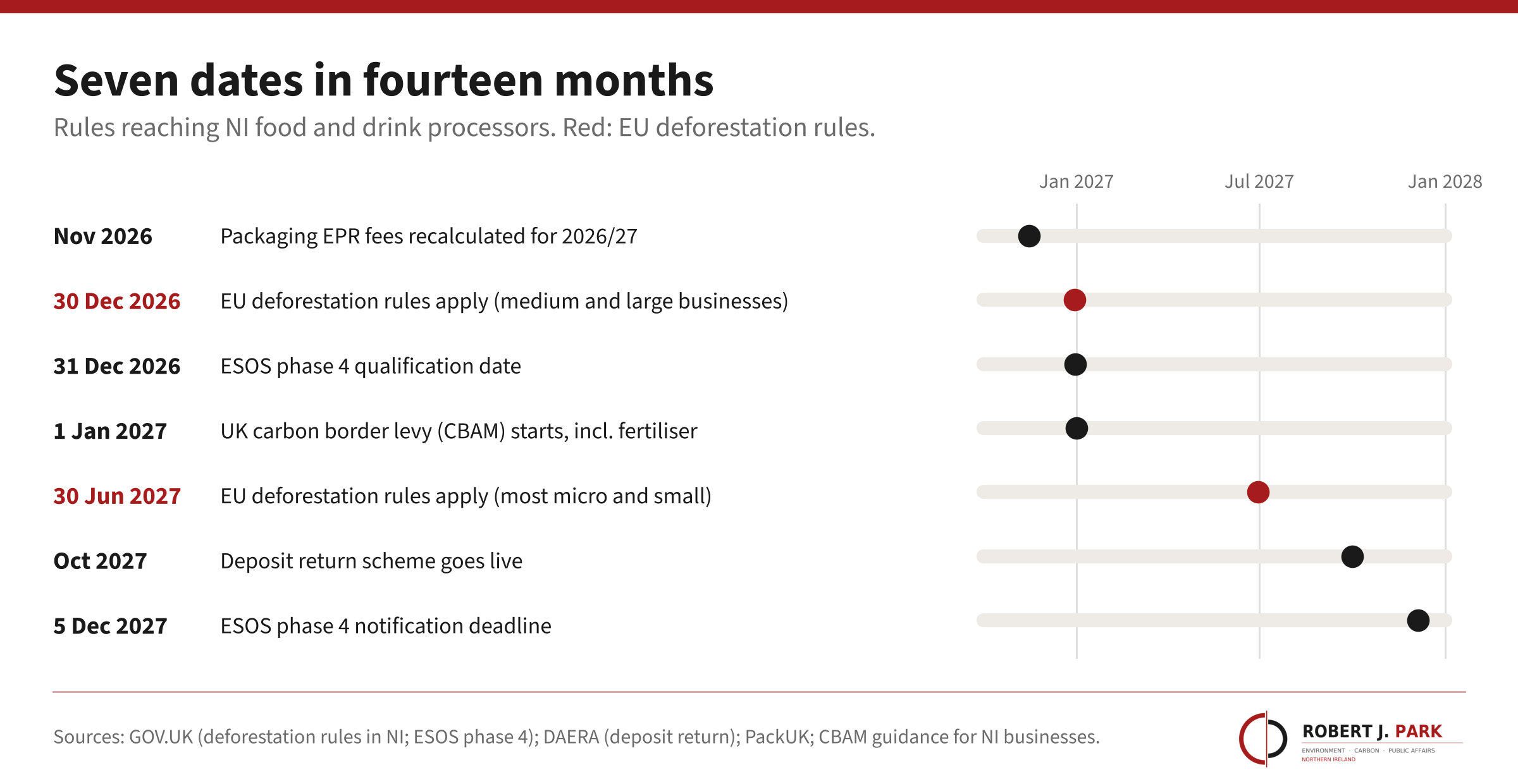
| When | What | Who it affects |
|---|---|---|
| Nov 2026 | Packaging EPR fees recalculated for 2026/27 | Packaging producers |
| 30 Dec 2026 | EUDR applies in NI (medium and large businesses) | Processors placing beef, cocoa, coffee, palm oil, soya or wood products on the NI market |
| 31 Dec 2026 | ESOS phase 4 qualification date | Businesses with 250+ staff, or over £44m turnover and £38m balance sheet |
| 1 Jan 2027 | UK CBAM starts, including fertiliser imports | Costs passed down the supply chain |
| 30 Jun 2027 | EUDR applies to most micro and small businesses | Smaller processors |
| Oct 2027 | Deposit return scheme goes live | Drinks producers and retailers |
| 5 Dec 2027 | ESOS phase 4 notification deadline | ESOS-qualifying businesses |
This monthThree things a processor can do
- List which of your raw materials fall under EUDR (cattle, cocoa, coffee, palm oil, soya, wood) and ask suppliers now for the plot locations and due diligence reference numbers you will need from 30 December.
- Check whether you qualify for ESOS on 31 December 2026. If you do, book an assessor early: a compliant audit takes months, not weeks.
- Build a simple Scope 1 and 2 baseline from last year's gas, oil and electricity bills, and rank your top ten raw materials by spend as the start of Scope 3.
See the numbers behind this briefing
The NI Food and Drink Processing dashboard sets out every figure used here: turnover from 2020, where sales go, NI emissions by sector, what the deforestation rules cover and who enforces them, and every deadline. Each chart can be downloaded as a CSV.
See the farm behind your Scope 3
The NI Agriculture and Land Carbon dashboard sets out the farm emissions, livestock and nutrient figures that sit in every processor's supply chain. Read it alongside last week's Focus on Agriculture.
The full briefingRead Focus on Food & Drink Processing
The full 6 pages, with the charts, deadlines and every source.
SourcesWhere the figures come from
- NI greenhouse gas inventory 1990–2024 statistical bulletin (DAERA/NISRA)
- NI food and drinks processing sector 2022 (NISRA, 10 April 2025)
- NI-produced food sales top £7bn (Irish News, 10 April 2025)
- NI Carbon Intensity Indicators 2025 (DAERA/NISRA)
- Deforestation-free products in NI (GOV.UK, updated 27 August 2026)
- PackUK Year 2 (letsrecycle, 4 March 2026)
- Deposit Return Scheme (DAERA)
- Food Waste Regulations (NI) 2015
- ESOS phase 4 guidance (GOV.UK)
- EU Sustainability Omnibus (Latham & Watkins)
- Soft Drinks Industry Levy changes, Autumn Budget 2025 (Deloitte Taxscape)
Focus on is a weekly briefing by Robert J. Park, an independent environment, carbon and public-affairs consultant based in Larne, Northern Ireland. Robert helps processors build carbon inventories, plan ESOS, CBAM and supply-chain reporting, and prepare for new packaging and deforestation rules.
Get in touch on LinkedIn or WhatsApp @robertjpark.