Focus on Construction & Building · 9 November 2026
Housing output rose by a quarter. Pipes, timber rules and carbon at the border now set the pace.
Building for a growing Northern Ireland: how contractors, developers and merchants can plan around wastewater limits, imported-materials rules and lower-carbon buildings.
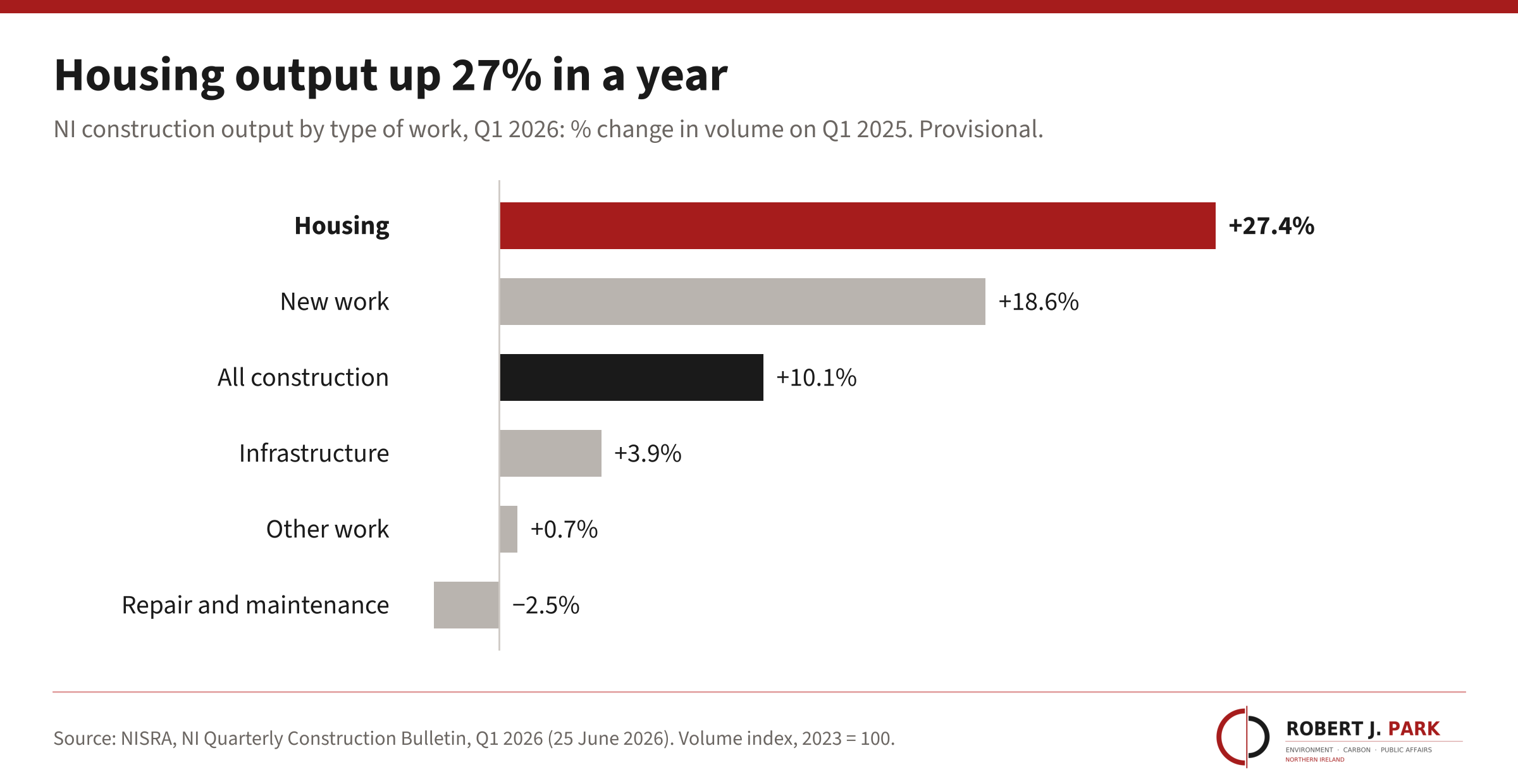
Construction in Northern Ireland has been busy. Output in the first quarter of 2026 was 10% higher than a year earlier, and housing work was up 27%. Output dipped in the second quarter but stayed 17.5% above its pre-pandemic level. The limits now are less about demand than about pipes, materials and rules: wastewater capacity decides where homes can connect, timber and imported steel come with new due diligence and carbon costs, and clients increasingly ask what a building will emit over its life.
Where emissions sitSpread across the inventory
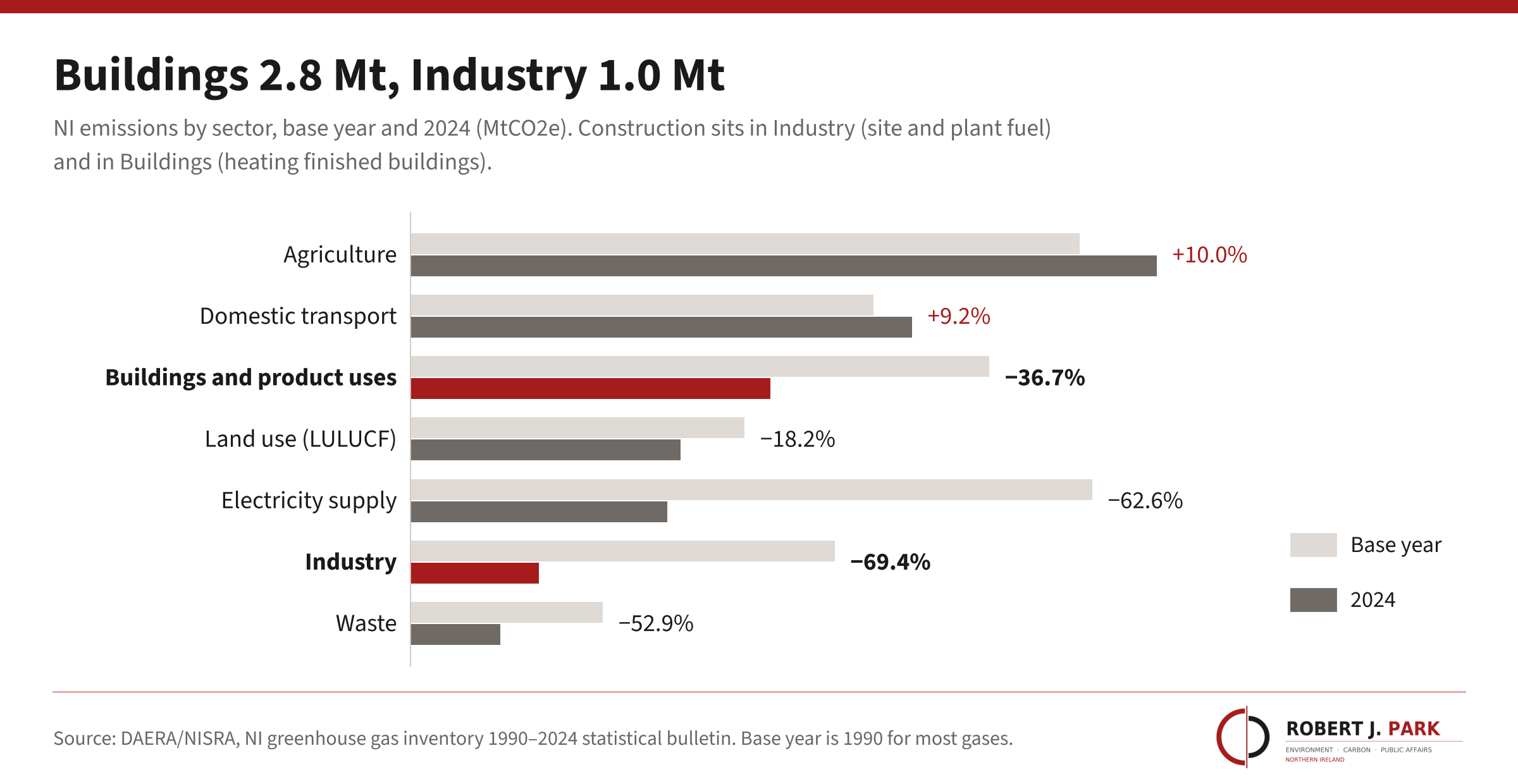
Construction has no line of its own in the NI greenhouse gas inventory. Fuel burned on sites and in cement and quarry plant is counted in Industry: 1.0 MtCO2e in 2024, down 69% since 1990, with cement among the largest long-term cuts. Heating finished buildings is counted in “buildings and product uses” (2.8 MtCO2e, 15.5%). Across the UK, the UK Green Building Council says the built environment is directly responsible for about a quarter of emissions, and around a fifth of that comes from construction and refurbishment rather than running buildings.
Scopes 1, 2 and 3Materials are the footprint
For a contractor, Scope 1 is diesel in plant and vans and fuel in generators. Scope 2 is site and office electricity. Scope 3 is dominated by materials (concrete, steel, aluminium, blocks, insulation, timber), plus haulage and waste. Lower-carbon concrete, steel with recycled content and designing out waste usually cut more emissions than anything done on site.
WastewaterThe real limit on new homes
NI Water estimates that around £7 billion is needed for wastewater capacity, environmental compliance and resilience. In Belfast, 156 of 192 storm overflows are classed as unsatisfactory, and capacity limits stop many proposed homes from connecting.
In March 2026 the Infrastructure Minister announced that developer contributions will start as a voluntary scheme, with a compulsory levy still under consideration. Extra departmental funding since autumn 2024 has unlocked capacity for 5,300 more homes. Developers should check connection capacity before buying land, not after planning is lodged.
Imported materialsTwo rules arrive within eight weeks
Update, 21 November 2026: the UK–EU summit of 20 November concluded an agreement to link the UK and EU carbon markets. The UK government says it intends to exempt goods of EU origin from UK CBAM from 1 January 2027; that is not yet law. What changes, and when.
UK CBAM. From 1 January 2027, imports of iron and steel, aluminium and cement of any non-UK origin will carry a carbon levy once a business's covered imports pass £50,000 in any 12 months. Rebar, sections, cladding and cement from Turkey, China or India will cost more and come with emissions paperwork, and so will supplies from the Republic of Ireland and the rest of the EU: HMRC says no jurisdiction is exempt, and relief covers only a carbon price actually paid. Only UK-origin goods are outside the levy, and steel bought from a GB stockholder is the stockholder's import, not yours, though expect the levy in the price. For 2027 and 2028, HMRC's default values, used when a supplier cannot provide verified emissions data, are one global figure per good; the 28 October Budget said they become country-specific from 2029. Importers that pass the threshold in 2027 must register by 31 January 2028.
EU deforestation rules. From 30 December 2026, the EU Deforestation Regulation applies in NI to wood and wood products, including some pallets and packaging. The business that first places timber on the NI market, often an importer or merchant, needs due diligence, and buyers need the reference numbers. Micro and small businesses get no extra time for timber: the later date of 30 June 2027 does not apply to wood products already covered by the old EU Timber Regulation, so for them too the date is 30 December 2026.
LandContaminated sites still rely on planning
Part 3 of the Waste and Contaminated Land (NI) Order 1997, which would create a statutory contaminated land regime, has still not been commenced. DAERA's work on the costs of a regime is ongoing, with completion possibly in 2027. Until then, contamination is handled mainly through the planning system, so brownfield developers carry the risk of what they find. A good desk study and early site investigation remain the cheapest insurance.
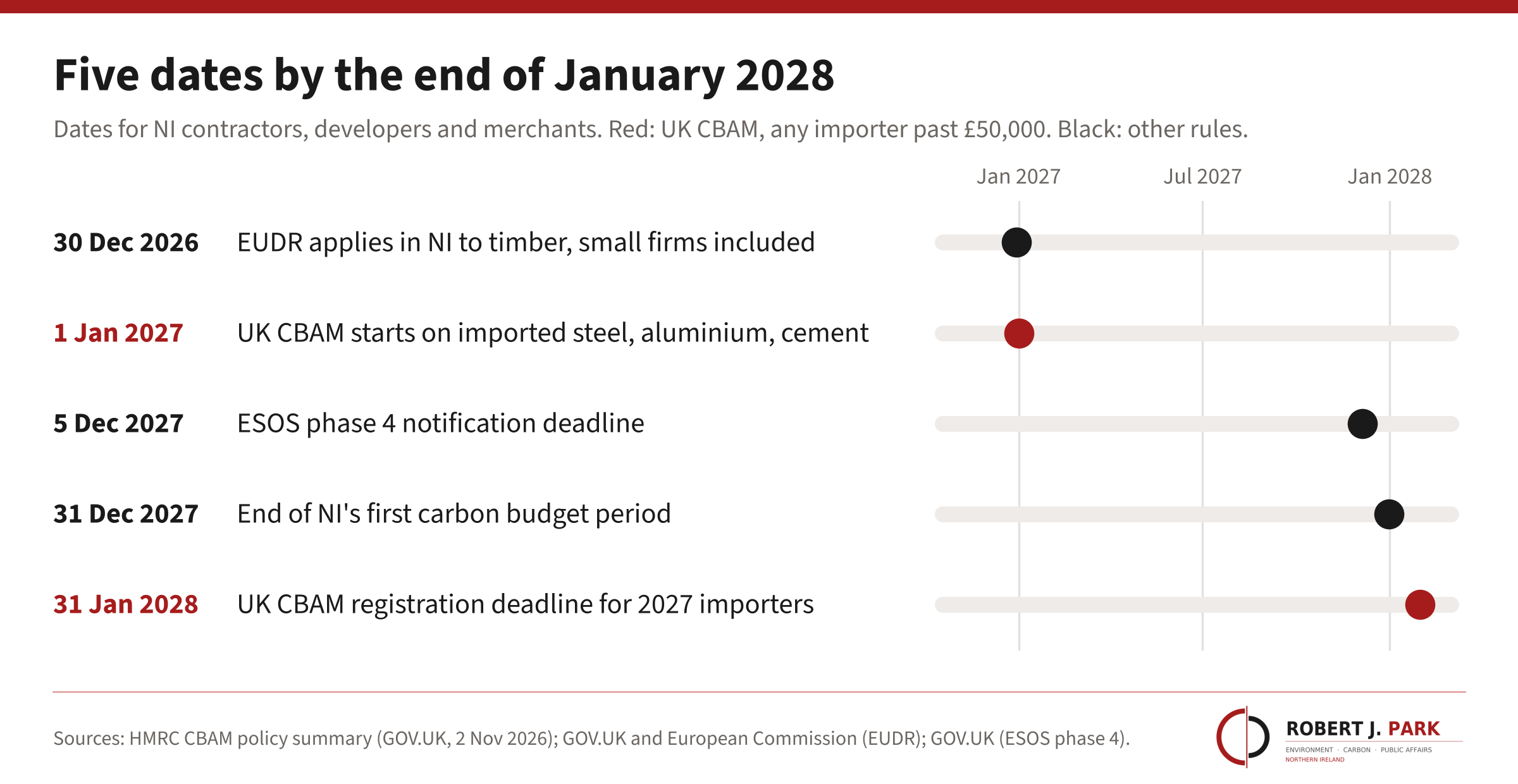
Policy and deadlinesFive dates by the end of January 2028
| When | What | Who it affects |
|---|---|---|
| 30 Dec 2026 | EUDR applies in NI to timber (businesses of all sizes) | Timber importers, merchants, manufacturers |
| 1 Jan 2027 | UK CBAM starts for steel, aluminium and cement | Importers of covered goods of any non-UK origin, EU included |
| 5 Dec 2027 | ESOS phase 4 notification deadline | Large contractors and developers |
| 31 Dec 2027 | End of NI's first carbon budget | All sectors |
| 31 Jan 2028 | UK CBAM registration deadline for 2027 imports | Importers that passed £50,000 |
This monthThree things a contractor or developer can do
- Ask your timber and steel suppliers in writing how they handle deforestation due diligence and CBAM, and what documents you will receive with each delivery.
- Check NI Water capacity for every site in your pipeline before committing to land or design.
- Estimate embodied carbon on one current project: the concrete, steel and timber quantities you already have are enough for a first figure.
See the numbers behind this briefing
The NI Construction and Building dashboard sets out every figure used here: output by type of work, housing growth, wastewater pressures, building and industry emissions, and the rules on imported materials and land. Each chart can be downloaded as a CSV.
Problem land, practical fixes
The free Land Repair Helix pairs land problems such as contamination, spills and poor drainage with low-cost, nature-based fixes, with printable site plans.
The full briefingRead Focus on Construction & Building
The full 6 pages, with the charts, deadlines and every source.
SourcesWhere the figures come from
- NI Quarterly Construction Bulletin, Q1 2026 (NISRA, 25 June 2026)
- Construction output statistics, Q2 2026 (NISRA, 24 September 2026)
- NI construction bulletin, July to September 2026: release date 14 January 2027 (GOV.UK)
- New dwelling starts fell by almost 750 over the year (DoF/NISRA, 19 August 2026)
- New dwelling statistics (Department of Finance)
- NI greenhouse gas inventory 1990–2024 statistical bulletin (DAERA/NISRA)
- Whole Life Carbon Roadmap FAQs (UK Green Building Council)
- NI Water update to Belfast City Council (NI Water, 28 January 2026)
- Developer contributions for wastewater infrastructure (DfI Written Ministerial Statement, 19 March 2026)
- Kimmins: voluntary contribution scheme will help address capacity concerns (DfI, 19 March 2026)
- Carbon Border Adjustment Mechanism: policy summary (HMRC, updated 2 November 2026)
- Budget 2026, HC 726, para 6.217 (HM Treasury, 28 October 2026)
- CBAM for Northern Ireland businesses (April 2026)
- Deforestation-free products in NI (GOV.UK, updated 27 August 2026)
- Delay until December 2026 and other developments in the implementation of the EUDR (European Commission, Access2Markets)
- Contaminated land (DAERA)
- ESOS phase 4 (GOV.UK)
Focus on Construction & Building is a monthly briefing by Robert J. Park, an independent environment, carbon and public-affairs consultant based in Larne, Northern Ireland. Robert helps contractors, developers and councils measure carbon, plan CBAM and deforestation due diligence, and deal with contaminated and difficult land, working with a multidisciplinary team.
Get in touch on LinkedIn or WhatsApp @robertjpark.