Focus on Metals & Manufacturing · 5 November 2026
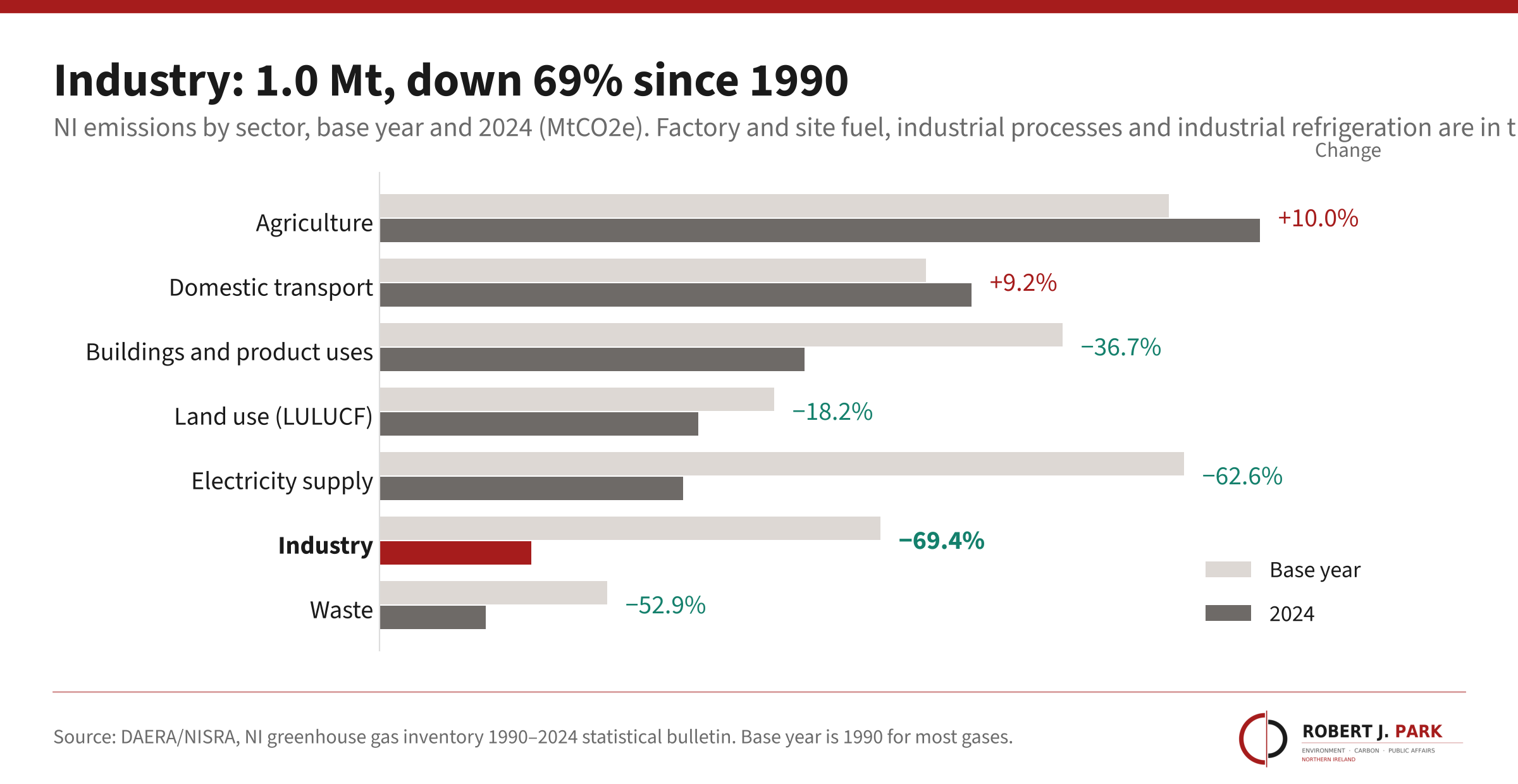
Industry emissions are down 69% since 1990. Now borders and customers want the numbers.
Making things for two markets: what UK CBAM, EU customer demands and carbon-market linking mean for Northern Ireland manufacturers.
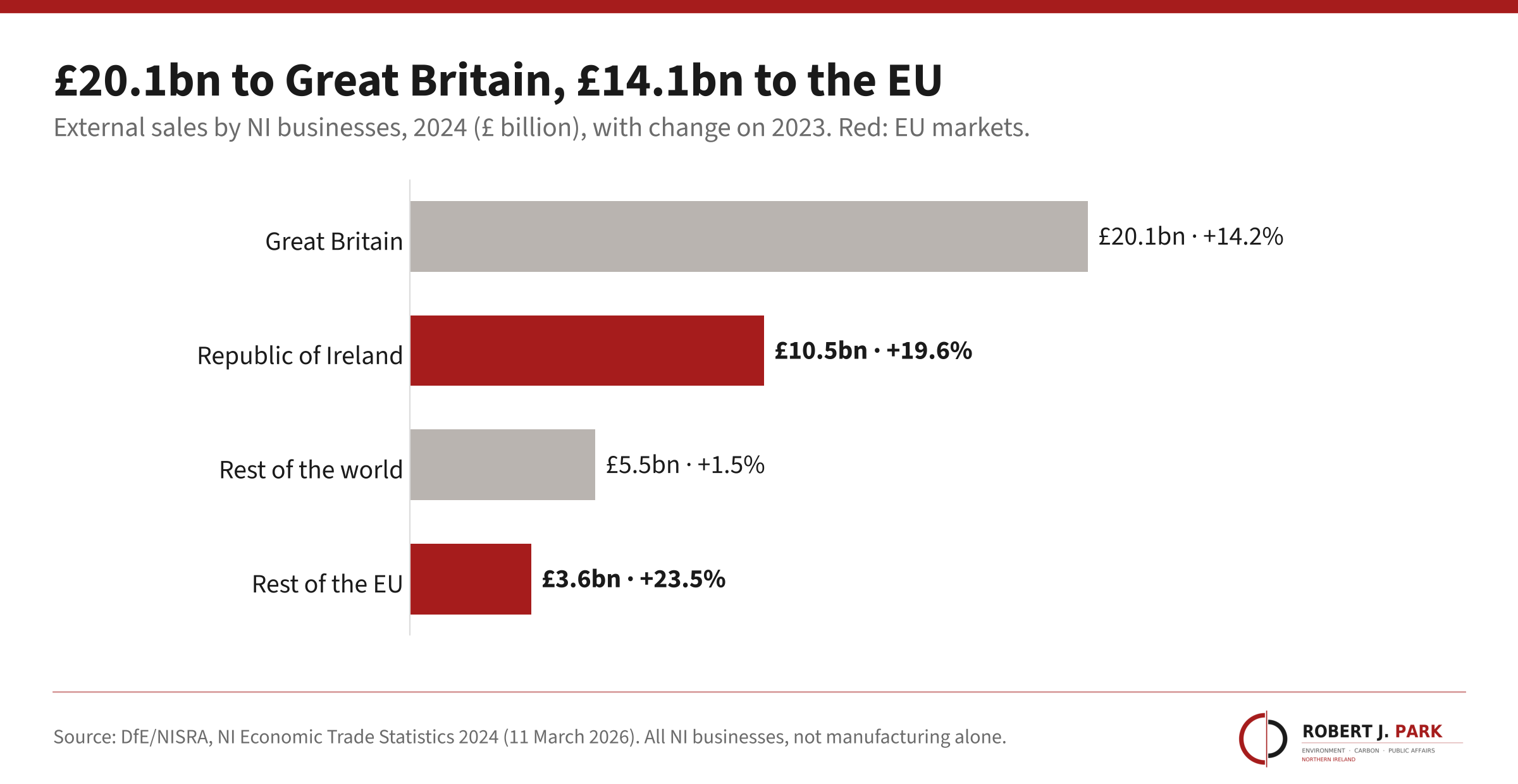
Northern Ireland industry emitted 3.3 million tonnes of CO2e in the 1990 base year. By 2024 it was 1.0 million, a fall of 69%. Manufacturing is about one in ten NI jobs and sells both ways: £20.1bn of NI sales went to Great Britain in 2024 and £14.1bn to the EU. From 1 January the UK's carbon border levy applies to imported steel, aluminium, cement, fertiliser and hydrogen of any non-UK origin, EU included, and EU customers already ask NI suppliers for emissions data. Manufacturers that can show their numbers are better placed to keep their contracts.
Where emissions sitThree industries did most of the cutting
Industry in the NI inventory covers fuel burned in factories and on construction sites, industrial processes and industrial refrigeration. The inventory attributes the long-term fall to lower emissions from food and drink, chemicals and cement; it does not say how much came from plant closures, process change or fuel mix. Electricity is counted separately, under electricity supply: half of NI's electricity now comes from renewables, against a legal target of 80% by 2030, so the electricity-related (Scope 2) emissions of NI businesses should keep falling as the grid gets cleaner. That lowers Scope 2 in a carbon inventory, not today's CBAM charges on steel or aluminium: the EU counts only direct emissions for those goods, and the UK leaves indirect emissions out until 2029 at the earliest.
The borderUK CBAM starts on 1 January
Update, 21 November 2026: the UK–EU summit of 20 November concluded an agreement to link the UK and EU carbon markets. The UK government says it intends to exempt goods of EU origin from UK CBAM from 1 January 2027; that is not yet law. What changes, and when.
From 1 January 2027, the UK importer of iron and steel, aluminium, cement, fertiliser or hydrogen of non-UK origin pays a carbon levy. That includes goods of EU origin: HMRC says no jurisdiction is exempt. Where a carbon price was actually paid under a recognised scheme such as the EU ETS, relief can be claimed for it, but emissions covered by free allowances do not count, and most EU steel and aluminium still gets free allowances in 2027. Only UK-origin goods are outside the levy. Glass and ceramics are left out at the start, and so are indirect emissions until 2029 at the earliest. The charge is in Part 5 of the Finance Act 2026; the last of five sets of regulations (SI 2026/995) was made on 8 September and comes into force on 1 January. HMRC's draft notice sets one global default value per good for 2027 and 2028, and the 28 October Budget said values become country-specific from 2029.
- Registration is triggered once non-UK-origin covered imports reach £50,000 in the previous 12 months (checked on the first of each month), or on any day when you expect them to reach £50,000 in the next 30 days. Imports before 1 January 2027 do not count.
- HMRC's registration service opens on 1 January 2028. Businesses that pass the threshold in 2027 have until 31 January 2028 to register.
- From 1 January, keep for each covered import the eight-digit commodity code, the date, the value, the net weight in kilograms and proof of origin. Records must be kept for six years.
- The first return and payment, for 2027, are due by 31 May 2028.
For an NI fabricator buying steel sections, bar or aluminium extrusions from Turkey, India or Spain, this is a new cost and a new data request to suppliers. If the mill cannot supply verified emissions data, you use HMRC's default value, which will usually cost more. Steel bought from a GB stockholder is the stockholder's liability, not yours, but expect the levy in the price. Using a freight forwarder does not shift the liability: the business named on the import declaration is the importer.
Two marketsEU customers ask for data
The EU's own CBAM entered its definitive phase on 1 January 2026. It does not apply in Northern Ireland: the European Commission's CBAM Q&A says “Goods produced and/or released for free circulation in Northern Ireland are not subject to CBAM” (Q 7.14), so goods dispatched from NI to Ireland or the rest of the EU do not trigger it. But EU buyers with obligations of their own ask their suppliers for embedded emissions data. And if you ship from GB or from outside the EU direct to an EU customer on delivered duty paid (DDP) terms, you or your EU customs representative become the CBAM declarant, so agree who carries that before you quote.
Linking the carbon markets. The EU authorised linking talks in November 2025, and a draft linking agreement was before the Council's working party on the UK on 10 November 2026; no text has been published. Leaders meet at the UK–EU summit in Brussels on 20 November, with emissions trading on the agenda alongside the agri-food deal. Once a full link is in force, and each side has legislated for it, goods covered by both CBAMs could be exempted from each other's charges. Until then, plan for both regimes. I will update this briefing after the summit.
ReportingFewer legal duties, more questions
The EU's sustainability reporting rules (CSRD) will apply only to groups with more than 1,000 employees and €450m turnover, and limit what they can demand from suppliers with fewer than 1,000 staff. The UK published its own Sustainability Reporting Standards in February 2026 for voluntary use; no mandatory date has been set.
ESOS energy audits remain compulsory for large businesses (250 or more staff, or turnover over £44m with a balance sheet over £38m): the phase 4 qualification date is 31 December 2026, and notification is due by 5 December 2027.
EnergyYour biggest controllable carbon cost
In a fabrication shop the bill is welding and cutting plant, compressors, high-bay lighting and space heating, which off the gas grid often means oil or LPG. Process heat matters if you galvanise, powder-coat, heat-treat or cast. The measures that usually pay back inside three years are LED lighting with controls, compressed-air leak repair and pressure reduction, variable speed drives on compressors and fans, and destratification fans or heat recovery into the shed. Invest NI's Energy Efficiency Capital Grant is paused while it is reviewed, so plan projects that stand up on their own.
Policy and deadlinesSix dates in eighteen months
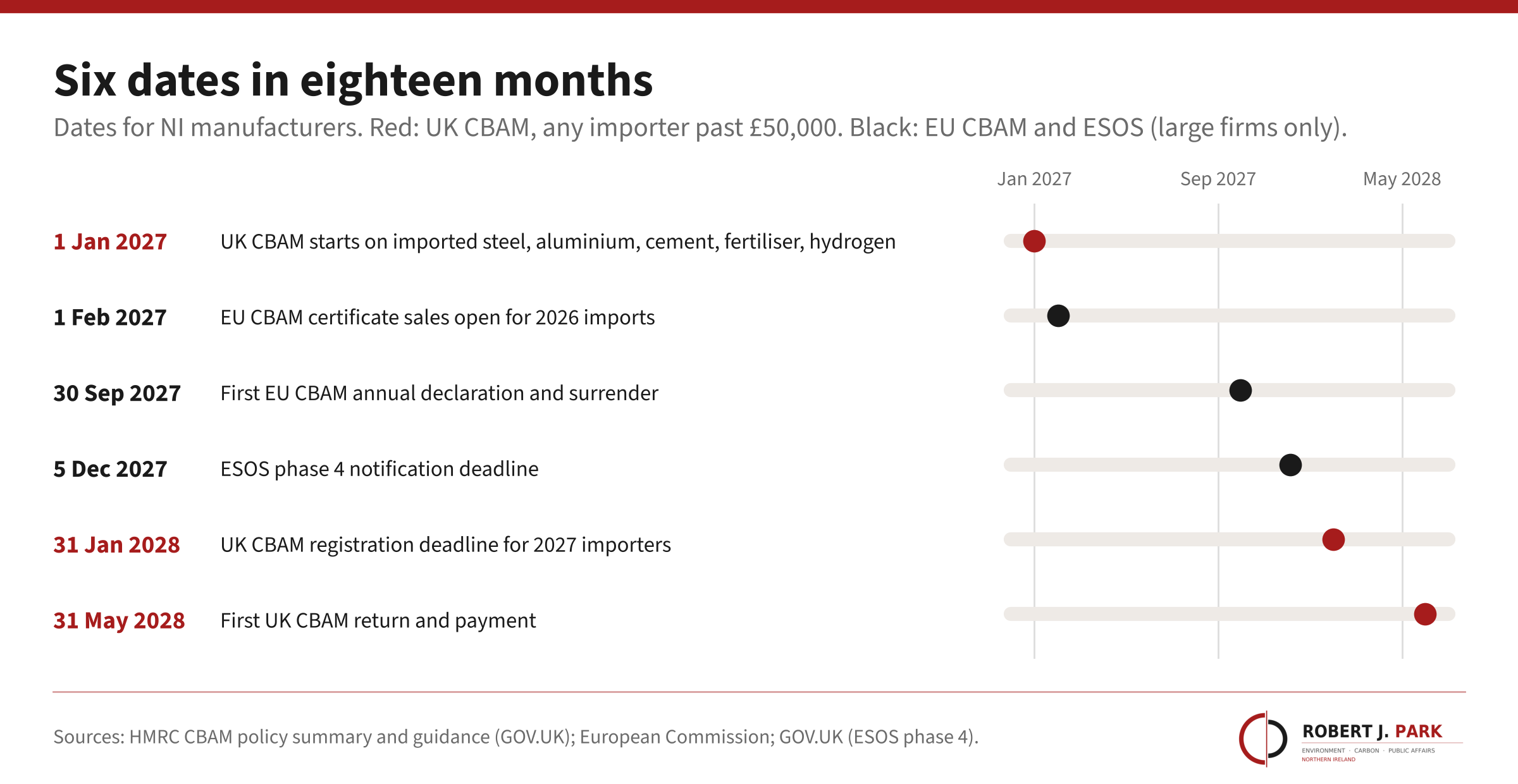
| When | What | Who it affects |
|---|---|---|
| 20 Nov 2026 | UK–EU summit: emissions trading link expected | All NI manufacturers |
| 1 Jan 2027 | UK CBAM starts | Importers of covered goods of any non-UK origin |
| 1 Feb 2027 | EU CBAM certificate sales open for 2026 imports | EU importers |
| 30 Sep 2027 | First EU CBAM annual declaration and surrender | EU importers |
| 5 Dec 2027 | ESOS phase 4 notification deadline | Large businesses |
| 31 Jan 2028 | UK CBAM registration deadline for 2027 (registration opens 1 Jan 2028) | Importers that passed £50,000 in 2027 |
| 31 May 2028 | First UK CBAM return and payment | Registered importers |
This monthThree things a manufacturer can do
- Pull last year's purchase ledger and total your imports of steel, aluminium, cement, fertiliser and hydrogen by country of origin, EU included. If non-UK-origin imports could reach £50,000 in any 12 months from January, set up the CBAM records now and ask each mill whether it can supply verified emissions data.
- Check the Incoterms on your EU sales. If you ship DDP from GB or from outside the EU, agree with your customs representative who acts as the CBAM declarant.
- Prepare a one-page statement of direct production emissions per tonne by product, including the mill's figure for the steel or aluminium you bought in. That is the shape of a CBAM data request. Keep a separate Scope 1 and 2 summary for customer questionnaires.
See the numbers behind this briefing
The NI Metals and Manufacturing dashboard sets out every figure used here: industry emissions against other sectors, where NI sales go, which goods each CBAM covers, the CBAM and ESOS dates, and progress on renewable electricity. Each chart can be downloaded as a CSV.
Which rules apply to you?
The free Incoterms Chooser finds the right Incoterms 2020 rule in four questions and flags NI, customs and CBAM points. The ESG Regime Tracker shows which UK, NI and EU carbon and sustainability rules apply to your business.
The full briefingRead Focus on Metals & Manufacturing
The full 6 pages, with the charts, deadlines and every source.
SourcesWhere the figures come from
- NI greenhouse gas inventory 1990–2024 statistical bulletin (DAERA/NISRA)
- NI Economic Trade Statistics 2024 (DfE/NISRA, 11 March 2026)
- Manufacturing and the Northern Ireland Economy (Manufacturing NI, May 2025)
- Factsheet: Carbon Border Adjustment Mechanism (HM Treasury and HMRC, GOV.UK)
- Check if you'll need to register for CBAM (HMRC, GOV.UK)
- Work out the date you'll need to register for CBAM (HMRC, GOV.UK, updated 20 October 2026)
- The Carbon Border Adjustment Mechanism (Emissions and Verification) Regulations 2026, SI 2026/995
- Budget 2026, HC 726, para 6.217 (HM Treasury, 28 October 2026)
- Carbon Border Adjustment Mechanism: policy summary (HMRC, updated 2 November 2026)
- UK CBAM: current qualifying carbon pricing schemes (HMRC, 27 August 2026)
- Keeping records for CBAM (HMRC, 3 November 2026)
- Check if you're classed as the importer for CBAM (HMRC)
- Getting the emissions intensity when importing CBAM goods (HMRC, 16 October 2026)
- Manufacturing energy efficiency guide (Carbon Trust)
- UK CBAM: what to expect, key dates and possible linkage to the EU (InterTradeIreland, October 2026)
- EU–UK relations: Council greenlights negotiations on linking emissions trading systems (Council of the EU, 13 November 2025)
- Working Party on the United Kingdom: draft agreement linking the EU and UK emissions trading systems, CM 4531/26 (Council of the EU, 10 November 2026)
- CBAM Questions and Answers, Q 7.12–7.14 (European Commission, updated 15 October 2026)
- EU Sustainability Omnibus (Latham & Watkins)
- Final UK Sustainability Reporting Standards (HSF Kramer, March 2026)
- ESOS phase 4 (GOV.UK)
- Electricity consumption and renewable generation, year ending June 2026 (DfE)
- Energy Efficiency Capital Grant (Invest NI)
Focus on is a briefing by Robert J. Park, an independent environment, carbon and public-affairs consultant based in Larne, Northern Ireland. Robert helps manufacturers build carbon inventories, plan UK and EU CBAM obligations, deliver ESOS with Lead Assessors, and answer customer carbon questionnaires.
Want your own number? Start with a free first call on the CBAM Desk. Email robert@robertjpark.co.uk, ring 07450 349480, or get in touch on LinkedIn or WhatsApp @robertjpark.